

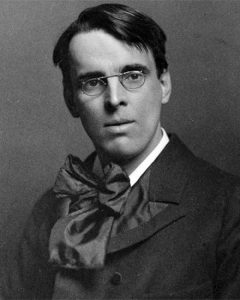
Once upon a time, Aleister Crowley and poet William Butler Yeats crossed wands in an epic magical grudge match!
A while back I posted an article about occultist Aleister Crowley, once described as “the Wickedest Man in the World.” Really, it depends on who you ask – Crowley was either a mystical philosopher and powerful practitioner of “Dark Magick” … or an evil cult leader and a spoiled, abusive buffoon.
His associate, the revered Irish poet William Butler Yeats, fell somewhere between the two camps. Yeats, who happened to be Crowley’s bitter rival and mortal enemy, was also a dedicated student of magic, describing it as “the most important pursuit in my life… The mystical life is the center of all that I do and all that I think and all that I write.”
Crowley would surely say the same, but his magic was of a much darker, more obsessive variety, and as a poet, he couldn’t hold a candle to Yeats.
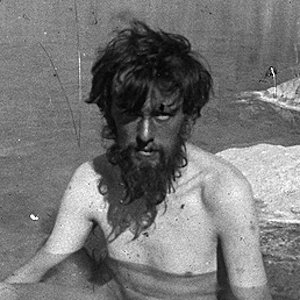
In case you’re interested, here’s a picture of a young Aleister Crowley sitting naked in a pond. (You’re welcome!)
Yeats and Crowley saw their conflict as a genuine war between competing forms of practical magic. Both men were both members of The Hermetic Order of the Golden Dawn, an exotic magical cult whose other members included writers Bram Stoker and Arthur Machen and famous magician Arthur Edward Waite.
Because Crowley showed a tendency to use his occult powers for evil rather than for good, Yeats and other members of the order decided not to allow him to be initiated into the inner circle; they feared that he would profane the mysteries and unleash powerful magic forces against humanity.
Crowley refused to accept their decision, and after launching some magical attacks on Yeats, he showed up at the Golden Dawn temple in London, loaded for bear. But Yeats and the other white magicians were ready for him!
Who was the victor in the Celebrity Magick Throwdown, 1900 Edition? Read more about the Crowley vs Yeats feud and where it led at OpenCulture.com!
I am baffled as to what may have been the exact nature of their magical experiments and “accomplishments” in these groups. How could any such belief stand the test of reality among educated men? Or was the supernatural conflict just a symbolic expression of their mutual loathing? Maybe it’s all too poetic for the average mind to grasp… Interesting cast of characters.