

In 1861, a railway engineer by the name of John White passed away and was buried in a cast iron coffin. After that, you might say he began a slow transformation from White to Blue. (Thank you, I’ll be here all week!)
In the case of Mr. White, in keeping with the styles of the time, his coffin had a glass window installed in the front so his face could be seen by mourners when the lid was shut. At some point after burial, the glass had broken, allowing groundwater to seep inside and react with the cast iron coffin and phosphate-rich body.
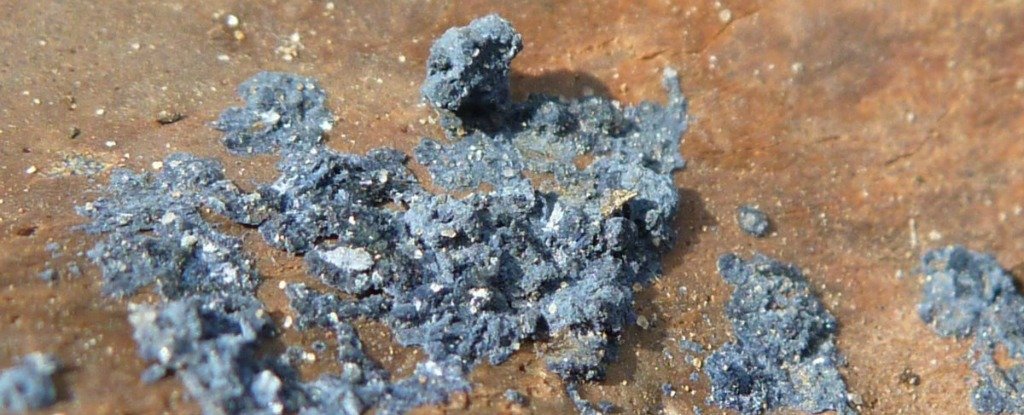
The end result was a corpse surround by blue vivianite crystals (also known as blue ironstone), revealed when the coffin was exhumed as part of an archaeological rescue excavation over a century after being buried.
The explanation for this spooky color change, which has occurred on numerous occasions all over the world, lies in the composition of the human body.
Vivianite has been used in jewelry, Lisa Holman. It has also been used as a paint pigment by NW Coast Native Americans, and in Europe by Rembrandt and Vermeer, among other artists.
Vivianite is used in agriculture, medicine, technology and art. It is a simple mineral with complex behaviors and diverse applications.
I wonder that no enterprising person has thought to somehow make use of this macabre mineral in jewelry making… Imagine how creepy to be able to say to the curious admirer, “Oh, this old thing? Used to be Aunt Helen.”