
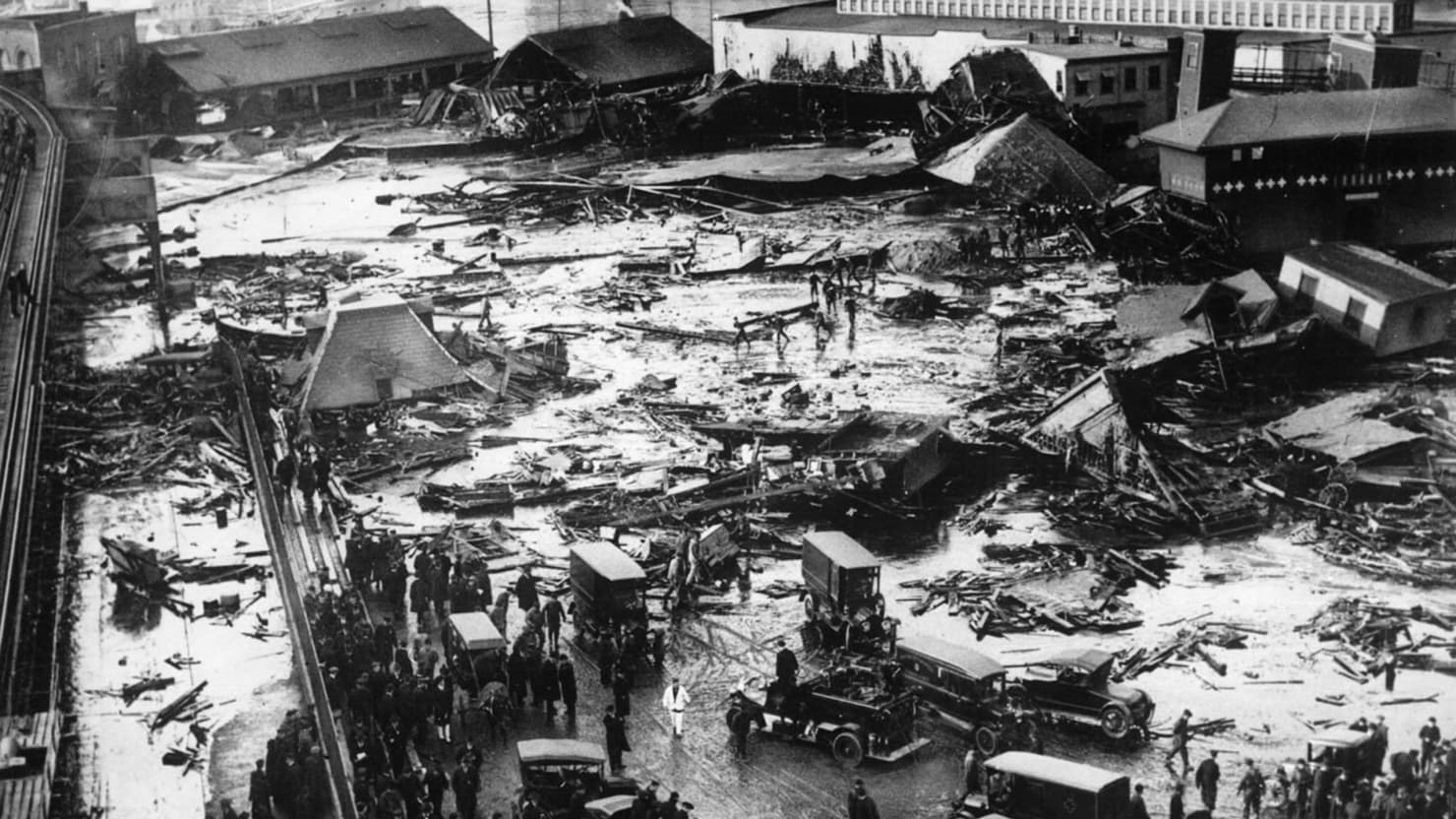
It was an unseasonably warm winter day in Boston, Massachusetts, when one of the strangest disasters in American history occurred exactly 99 years ago this week.
The Great Molasses Flood of 1919 was a deadly incident involving the explosion of a massive tank of molasses and the subsequent tidal wave of sweet, sticky death that ensued. Few people have heard of it, but the event has been described as “America’s Pompeii.”
*****
As Rod Serling might say, “Imagine if you will…”
It was January 15, 1919, and Boston was experiencing a January thaw; in fact, the temperature climbed up into the mid-40s – unseasonably warm for Boston in midwinter.
Down near the docks, right on the waterfront, sat a huge, rusty, leaking metal tank, 50 feet high and 90 feet across, containing 2.3 million gallons of molasses.
If you’re wondering why there would be a giant tank of molasses in Boston, remember that molasses – the residue that’s left over after sugar cane is boiled to make sugar – is one of the principal ingredients in making rum.
Boston was a major player in the colonial-era “triangular trade” of molasses, rum, and slaves. Basically, plantations in the West Indies colonies grew sugar cane, which they processed into molasses and shipped to Boston, where it was made into rum. Then ships took the rum to Africa and traded it for slaves, who were then sold in the West Indies to acquire more molasses, starting the cycle all over again.
Even after the slave trade ended, there was still a thriving market for rum, so molasses would always be in demand. It was also used for baking and in animal feed and was even a component of some World War I munitions.
In this case, the molasses in the ill-fated tank was going to be used to make distilled industrial alcohol rather than drinkable spirits. Prohibition, coincidentally, would take effect on the following day.
*****
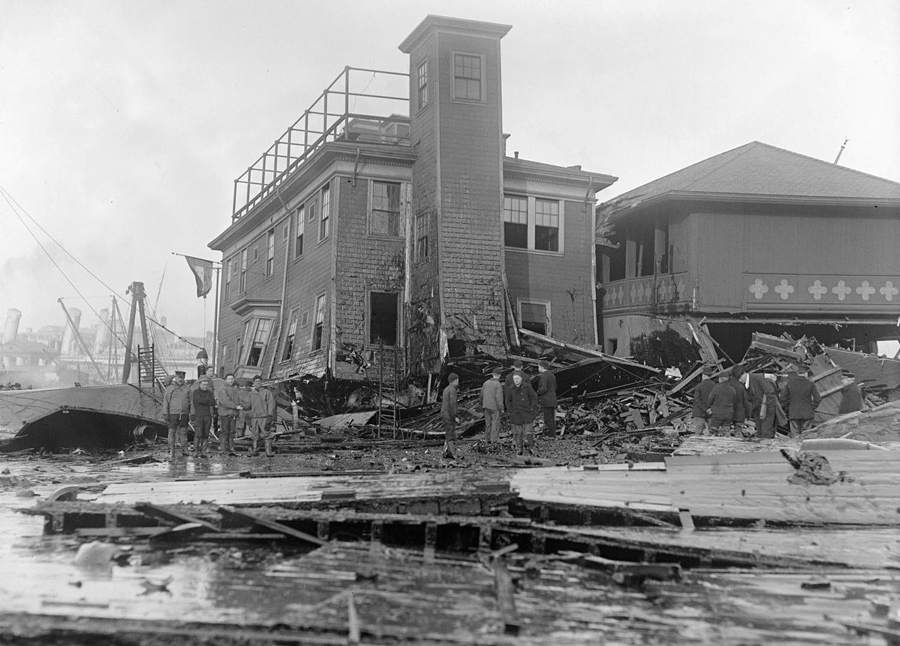
Firehouse #31
At around half-past noon on January 15, 1919, eyewitnesses first reported hearing a loud rumbling, followed by what sounded like machine-gun fire as the half-inch metal rivets from the tank were blown apart and flew through the air like shrapnel.
Then came the explosion. The force was so great that it caused some buildings to collapse and knocked others off their foundations. The vacuum it created then pulled down even more buildings, dragged a truck across the street, and pulled a train off its tracks. The local firehouse was actually torn from its foundation.
And then within seconds came the molasses tsunami.
As the walls of the tank collapsed, it propelled a thick, sticky wave of destruction through the crowded streets of Boston’s North End neighborhood.
Eyewitnesses described a 40-foot tidal wave of hot brown goo barreling down Commercial Street at more than 50 feet per second, accelerated by its sheer weight, obliterating all the people, animals, electrical poles, and buildings in its path.
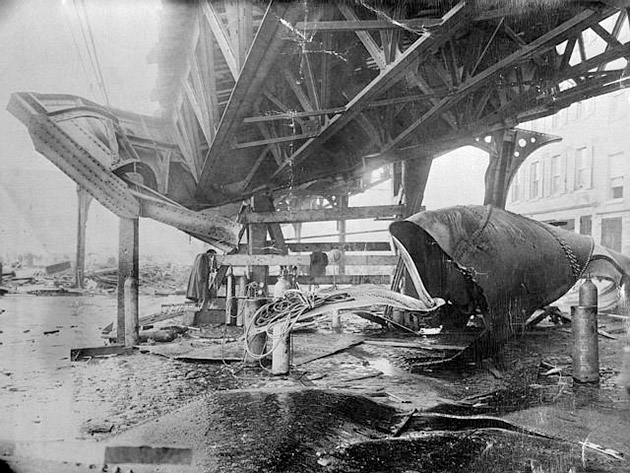
Even the steel supports of the elevated train tracks were snapped. Two city blocks were submerged within seconds.
The wave moved so quickly and so forcefully, it would have been impossible to outrun it. And anyone unlucky enough to be in its way didn’t stand much of a chance. People and animals were either flattened and crushed or drowned in the goo.
The high pressure from the exploding tank liquefied the molasses, allowing it to move quickly as a wave. But then as it came in contact with the cooler air outside the tank, it became more viscous and covered the neighborhood in a layer of thick, sticky goo about 2 to 3 feet thick.
A flash flood of any kind would have been devastating, but the extremely viscous nature of the molasses made survival and rescue attempts much more difficult.
Medics and police officers arrived on the scene quickly, but rescue efforts were hampered as they had to slog through sticky waist-deep sludge to reach victims. First responders and Good Samaritans alike also became stuck in the mess and had to be rescued themselves.
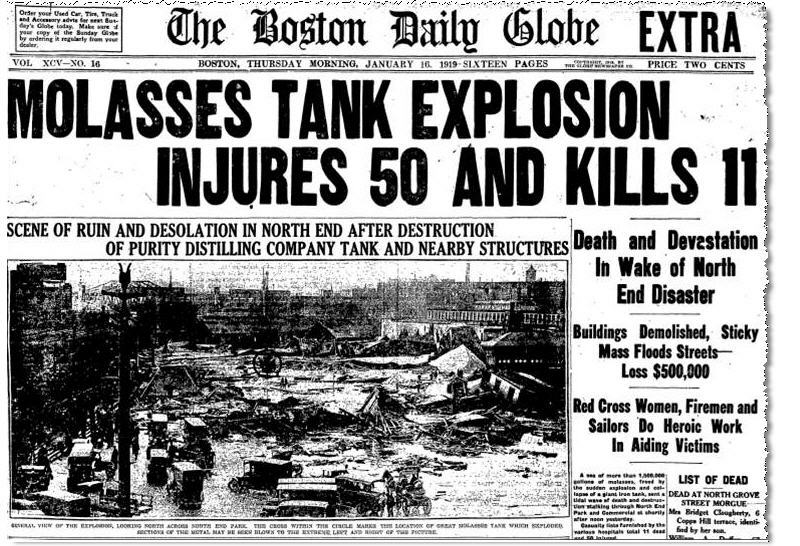
The Boston Post reported:
“Molasses, waist deep, covered the street and swirled and bubbled about the wreckage … Here and there struggled a form – whether it was animal or human being was impossible to tell.”
“Only an upheaval, a thrashing about in the sticky mass, showed where any life was … Horses died like so many flies on sticky fly-paper. The more they struggled, the deeper in the mess they were ensnared. Human beings – men and women – suffered likewise.”
In the end, the death toll included 21 men, women, and children, 12 horses, and many dogs, cats, and other animals who happened to be in the wrong place at the wrong time. Over 150 people were injured. The property damage alone was over $100 million in 2018 dollars.
*****
The owner of the tank, Purity Distilling Company, was eager to find someone else to blame for the disaster. Just hours later, the company’s lawyers were spreading the word claiming that Italian anarchists – the terrorists du jour of the early 20th century – were responsible.
Soon the company found itself under siege by 125 lawsuits on behalf of the victims and property owners. After six years of litigation, it was determined that the company was liable for the disaster, and they were ordered to pay compensation to the families of each the victims. In the end, this only amounted to about $7000 for each loved one lost.
Neighbors claimed the tank had been leaking ever since it was built, and the company been aware of it for some time. Their response was to do a bit of recaulking and paint the tank brown so the leaks wouldn’t show.
In the end, it was discovered that numerous design flaws and shoddy construction were the causes of the tank’s failure. The man who oversaw its construction wasn’t an engineer; he didn’t even know how to read a blueprint. In fact, no engineer was ever even consulted on the project. The company just needed a big tank in a hurry, so they threw one together as fast and as cheaply as possible, cutting every corner… including such niceties as safety inspections and testing.
Not only was the tank poorly designed, but the walls themselves were simply too thin to hold over 2 million gallons of molasses. Worse yet, they were made from a type of low-manganese steel that is especially susceptible to fracture – the very same type of steel that was used on the Titanic.
*****
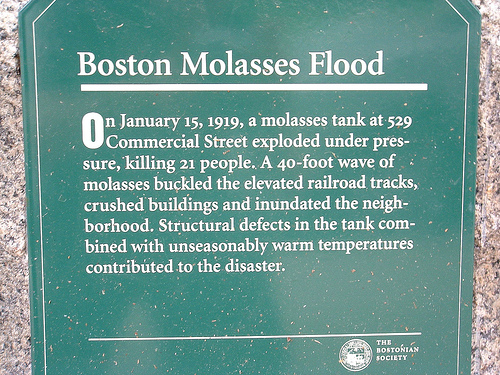
There isn’t a great deal of tourism around the Great Molasses Flood – the incident isn’t exactly a source of civic pride. If you’d like to visit the site of America’s most bizarre disaster, you can find the memorial plaque in Puopolo Park, just a small detour off the self-guided Freedom Trail Tour in Boston’s North End. It’s located right behind Copp’s Burying Ground.
Or you can follow your nose… some say that a faint ghostly whiff of molasses can still be detected on warm summer days when the wind is right.
Wow. And week later my Dad was born… he never did like rum.