
Thank you, Haunted Pittsburgh, for sharing this fascinating story from Pittsburgh’s macabre history!
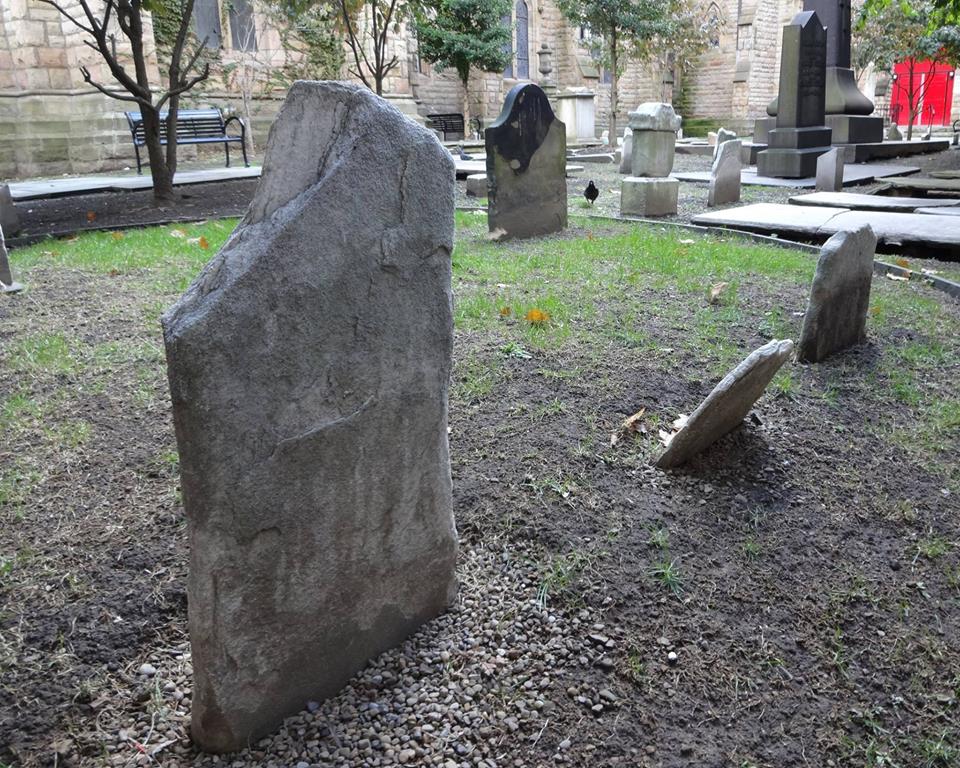
Every day, thousands of pedestrians stroll past the imposing churches on Sixth Avenue without realizing they are within a few feet of the dead. Across the street from the Duquesne Club, a sanctuary of quiet majesty sits between the First Presbyterian Church and the Trinity Episcopal Cathedral–it’s the Trinity Burying Ground, Pittsburgh’s oldest graveyard and one of its most historic places.
Not to put too fine a point on it, but some of the bodies lie awfully close to that sidewalk. And some may be closer to the surface than we care to imagine–April 24, 1877: landscapers in the graveyard inadvertently dug up a coffin just 18 inches beneath the ground.
It is sacred ground. There used to be an ancient Indian burial mound there. Then when the French established Fort Duquesne at the Point, they couldn’t bury their dead there because the Point was prone to flooding, so they took a cue from the Native Americans and buried them on higher ground, at the site of the present day Trinity graveyard. Soon, the British ousted the French from Fort Duquesne, and the burial ground became a British cemetery. Eventually, it became Pittsburgh’s most revered place for the dead.
WHO’S WHO OF WESTERN PENNSYLVANIA
William Penn’s heirs owned the land that is now downtown Pittsburgh, and on Christmas Eve 1787, they deeded away most of this block to two churches–half to the Presbyterian Congregation of Pittsburgh, and half to the Church of England. There used to be 4,000 graves in the Trinity Burial Ground, and the graveyard took up the block between Smithfield and Wood. It’s a lot smaller now–a lot of the bodies were moved to other cemeteries.
The gravestones are echoes of an epoch that built a mighty nation. The names of many who were buried there are well known to Western Pennsylvanians: General John Neville (Neville Island); Major Isaac Craig (Craig Street in Oakland); Colonel Stephen Bayard (Bayard Street in Shadyside); General William Butler and Colonel James Butler (Butler County); Oliver Ormsby (Mt. Oliver); Sarah and Jane Ormsby (Sarah and Jane Streets in South Side); and John Wilkins, Jr. (Wilkinsburg).
The most prominent grave belongs to Miu-Qua-Coo-Na-Cam, a Shawnee Indian chief also known as “Red Pole,” who died in Pittsburgh on January 28, 1797 after brokering peace between the U.S. government and Indian tribes. The U.S. Secretary of War ordered that his tombstone include these words: “Lamented by the United States.” In the October 3, 1947 Pittsburgh Post-Gazette on page 17, there’s a bizarre photo of famed film director Cecil B. DeMille, surrounded by several Seneca Indians, smiling next to Red Pole’s grave. (DeMille was in town for the premiere of “Unconquered,” his French and Indian War film set in Pittsburgh. The premiere was at Loew’s Penn Theater on Sixth Street—it’s now called Heinz Hall.)
ONE OF PITTSBURGH’S GREATEST TALES
One of the most famous inhabitants of the graveyard (though his gravestone has disappeared and it’s not clear where his body lies) is Tarleton Bates—Bates Street in Oakland is named after him. Bates’ funeral was the best attended our town had ever seen up to that time. The back-story to his death is one of Pittsburgh’s greatest tales.
At the end of 1805, Bates was the Prothonotary of Allegheny County (digression: President Harry Truman once famously asked, “What the hell is a prothonotary?”). Bates was also editor of a political newspaper. On Christmas Day, 1805, rival newspaper editor Ephraim Pentland branded Bates an “abandoned political miscreant”—apparently a terrible insult, because eight days later, Bates beat Pentland with a whip on Market Street.
Beatings have consequences. On January 5, 1806, Pentland challenged Bates to a duel—the challenge was delivered by a merchant named Thomas Stewart. Bates concocted an excuse to decline, so Pentland put up posters around town calling Bates a “coward and a poltroon.”
Calling someone a “coward and a poltroon” has consequences. Bates responded by insulting Pentland’s messenger, Thomas Stewart, in the pages of his newspaper. This prompted Stewart, on January 7th, to challenge Bates to his own duel. (Are you following this? In the span of just two days, the Allegheny County Prothonotary was challenged to two duels to the death.) This time, Bates accepted.
On the evening of January 7th, Bates dictated his will, and the next morning at dawn–a cold and damp January the 8th, 1806–Thomas Stewart and Tarleton Bates met on a farm in what is now Oakland, near what is now the base of Bates Street, and they engaged in Pittsburgh’s last recorded duel.
The two men stood in the traditional sidestance dueling pose—right leg in front of the left, peering over their right shoulders with their shooting arms extended. Bates refused one last invitation to apologize. Someone gave the commands, “Ready? Fire!”
The “pop-pop” of pistols punctured the frigid air. When the smoke had cleared, both men were still standing–so they fired again. This time, Stewart’s bullet landed directly in Tarleton Bates’ chest. His body crumbled to the frozen ground, and within an hour, he was dead.
The Bates family rejoiced that Tarleton had accepted the challenge and preferred “death to a life of infamy and disgrace.” Me, I’m very much okay with “infamy and disgrace” if it keeps me from getting shot in Oakland.
Thankfully, our modern day political rivals no longer attack each other with pistols at dawn. They use ten-second sound bites on cable television news.
Haunted Pittsburgh’s Ghost Tours are selling out for the 2017 Halloween Season. Click here to book your tour while there’s still time!
I’ve always wanted to go on a trip up north to visit old colonial sites, and I think this one just got added to the list. Especially because I love visiting cemeteries! The older the better. And I live juuust far enough south and west that it’s pretty hard to find anything older than the 19th century.