

Roasted at the Stake (1971). Artist: Ron Embleton
The confluence of Pittsburgh’s Three Rivers is home to many restless ghosts. Could wartime atrocities that occurred there 263 years ago be responsible for the high level of paranormal activity?
Courtesy of our friends at Haunted Pittsburgh, please enjoy this horrifying (yet educational!) tale of gruesome incidents that happened here in our hometown during the French and Indian War – aka “Dress Rehearsal for the American Revolution.”
*****
On July 9, 1755, the mighty British army under Major General Edward Braddock planned to take Fort Duquesne from the French at the Forks (known to Pittsburghers as “the Point”). The British and French knew that whoever controlled The Forks would rule the vast Ohio Country–and the continent. The British had every expectation of victory under the imperious Braddock, who was assisted by an ambitious Virginia militia officer named George Washington.
Braddock’s army camped at the present day site of Kennywood Park, then shortly after crossing the Mon, unexpectedly met up with–and was routed by–the French and their Indian allies at what is now the town of Braddock. The British were unaccustomed to the Indians’ guerrilla-style warfare. Benjamin Franklin had warned Braddock about it, but Braddock would hear none of it: “These savages may, indeed, be a formidable enemy to your raw American militia,” Braddock said, “but upon the king’s regular and disciplined troops, sir, it is impossible they should make any impression.” But make an impression they did–the British casualties were staggering. More than two-thirds of the soldiers Braddock led were killed or wounded. Braddock, himself, was fatally wounded and died several days later. Among his dying words were, “Who would have thought it?” The loss shook the British Empire to its core.
The Battle of the Monongahela altered the trajectory of a world war, the Seven Years’ War that George Washington had unwittingly ignited the year before in the Battle of Jumonville Glen near Fort Necessity. And it helped set in motion events that ultimately led to the American Revolution.
But we can’t sweep the gruesome part under the rug. At dusk on that July 9th, the French troops returned to Fort Duquesne with their prizes—twelve captured British soldiers. The captives had been stripped and their faces painted black. The Indians followed in short order—dancing, yelling, and frantically waving the bloody scalps of the British soldiers they had slaughtered.
And then, the most horrific thing imaginable happened. The captured British soldiers were marched to the banks of the Allegheny facing the present day site of Heinz Field. The Indians tied one prisoner to a stake and proceeded to torture him with red hot irons. Then they stuck him full of pine splinters—and burned him alive.
The hapless man’s shrieks of terror were drowned out by the Indians’ gleeful shouts as they danced in ghoulish celebration around their burning victim. The other prisoners watched in dread, knowing they were about to suffer the same fate. Then, one by one, each prisoner was tortured to death in the same horrific manner, to the twisted delight of their captors.
Fast forward three years. In London, Secretary of State William Pitt tapped General John Forbes to retake the Forks, once and for all. Forbes, along with—you guessed it, George Washington—and an army of 5,000 troops, make their way across Pennsylvania, east to west, over a road they cut starting in Carlisle, and they establish forts along the way.
At one of those forts—Fort Ligonier—Col. Henry Bouquet gives Major James Grant permission to take 800 troops, including Scottish Highlanders replete with bagpipes and plaid kilts, to reconnoiter—observe, not capture—Fort Duquesne.
In the pre-dawn blackness of September 14, 1758, Major Grant stood near the the present day site of the Allegheny County Courthouse on Grant Street (named after him years later). He’d done something General Braddock was unable to do—he’d come within sight of the Forks, undetected. The soldiers in the fort below, and the Indians in the village outside it, were fast asleep. Without any authority, Grant decided he was going to retake the Forks for the British. He divided his men in four groups and sent them creeping toward the Fort.
But then, as dawn breaks, Major Grant does the unthinkable. He orders the 77th Highlanders to sound the reveille—the drums bang and the bagpipes wail—and every living creature at the Forks is awakened. The French and the Indians swarm out in massive numbers to intercept the British—it’s Braddock all over again. Grant’s men are butchered with unspeakable cruelty—they’re burned alive, drowned in the rivers, and decapitated. Three hundred British soldiers die, and the “Battle of Fort Duquesne” is yet another decisive British defeat.
*****
Today, the Fort Pitt Museum at the Point is teeming with tales of spiritual manifestations, no doubt the residue of the place’s gruesome past. After closing hours, security guards sometimes see the shadows of dead soldiers moving around the building. Sometimes at night, guns and other artifacts on display in one part of the museum end up at the other end of the museum in the morning. Sometimes, it’s been said, the mannequins exchange shoes overnight to mess with people’s minds. Maybe the dead soldiers just want people to know they are still there.
Whether any of it is true is not for us to say. But if any place in Pittsburgh should be haunted, it’s this one.
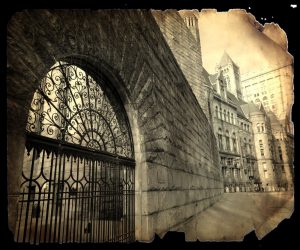
Haunted Pittsburgh will launch its 2018 Season on Saturday, July 7th with a special VIRTUAL Ghost Tour event at the Oaks Theater in Oakmont with master tourguide Haydn Thomas. The Downtown Pittsburgh walking Ghost Tour season begins on Friday July 13th (!) and continues every Friday and Saturday evening through early November.