
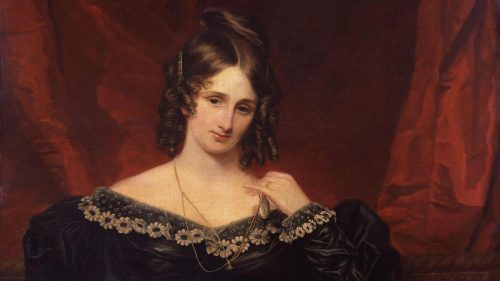
Mary Wollstonecraft Godwin Shelley, 1831
It’s hard to believe that the story of Dr. Frankenstein and his monster is now 200 years old. That’s right. In 2018, Frankenstein, or the Modern Prometheus – one of the greatest horror stories in literary history – celebrates its bicentennial year.
Since the horrific yet tragic tale of the mad scientist and his tortured creation was first published in 1818, it’s been the subject of over 60 movies (the first one by Thomas Edison in 1910), TV shows, countless literary adaptations, and of course, Halloween costumes.
Perhaps the strangest part of Frankenstein’s creation is that the nightmarish story of decaying churchyards, grave robbing, stitched-together reanimated corpses, murder and mayhem actually sprang from the imagination of a pregnant teenager.
Her name was Mary Wollstonecraft Godwin Shelley – a brilliant woman and an accomplished writer who kept company with some of the great authors, poets, and philosophers of her time. Though her life was fraught with tragedy from the very beginning, it was quite an extraordinary life, and a brave one for a woman of her day.

Mary was born in 1797 to intellectual power couple, William Godwin and Mary Wollstonecraft. Both her parents were famous free-thinkers, authors, and philosophers, particularly in the political realm.
Her mother was one of the foremost feminists of her time and was the author of A Vindication of the Rights of Woman, where she advocated a number of radical positions on women’s rights, especially the right to an education and to earn a living… shocking stuff for the late 18th century! (Wollstonecraft’s book is still significant in feminist literature even today.)
Sadly, Mary never knew her illustrious mother. Mary Wollstonecraft died of puerperal fever 10 days after her daughter’s birth. Godwin was left alone to raise Mary and her half-sister, Fanny (her mother’s daughter from a previous relationship). As most widowers with young children did in those days, Godwin needed help managing his children and his household, and when Mary was four, he married a neighbor, Mary Jane Clairmont.
Talk about your wicked stepmothers… the new Mrs. Godwin had two children of her own when she entered the marriage and had another child with Godwin in 1803. She clearly preferred her own children over Mary and Fanny. Family life in the blended household was pretty dysfunctional, with mutual dislike and resentment fueling frequent clashes between the strong-willed Godwin girls and their stepmother.
Though she showed a great deal of intellectual promise, Mary received little formal education – Mrs. Godwin saw to the education of her own daughter but neglected to make any effort on Mary’s behalf.
With intensive tutoring by her father, Mary was mostly homeschooled. European and American intellectuals – writers, poets, and philosophers – were frequent guests at the Godwins’ house, where it wasn’t unusual to find Samuel Taylor Coleridge or William Wordsworth reciting poetry in the drawing room. A number of eccentric geniuses and rule-breaking personalities of that era passed through the Godwin household, and between their influence and her access to her father’s substantial library, Mary overcame the handicap of being denied a formal education.
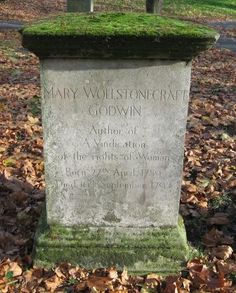
Mary Wollstonecraft’s grave in St. Pancras Old Church Graveyard, London
Mary liked to spend her “hours allowed for recreation” engaged in writing stories and poems; one of her poems, written in 1807, was published by her father’s company. Biographers mention that she spent a lot of time reading and daydreaming by her mother’s grave – which also afforded an escape from her unpleasant home life.
Mary read her mother’s works over and over again, and she mentioned later in life that she always felt pressure to live up to her mother’s expectations.
In an attempt to help shape her political philosophy and intellectual development (not to mention putting some distance between Mary and her stepmother for a summer), Godwin sent 14-year-old Mary to stay with family friends in Scotland in the summer of 1812. Mary bonded tightly with the Baxters, and for the first time, she knew what it was like to live in a happy home. Her visit was so successful, in fact, that she was invited to return the following year.
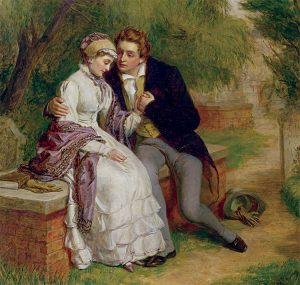
It was probably between her visits to Scotland that she became acquainted with 19th-century bad-boy Percy Bysshe Shelley – a rogue poet and an admirer of her father’s… not to mention a married man. The two fell in love, often meeting in the cemetery at Mary’s mother’s grave – and legend has it that this was where their relationship was consummated.
Depending on your perspective, it was either a sordid affair or a romance for the ages.
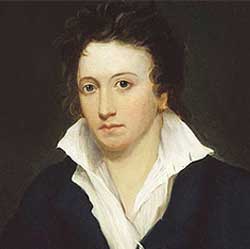
Percy Bysshe Shelley
Despite warnings from both families, the illicit lovebirds ran off together to France – Mary was 16 at the time, Percy a few years older… and married to someone else. Mary’s stepsister, Claire Clairmont came along for the ride. Shelley’s pregnant wife, Harriet, was of course left behind. Mary’s father disowned her, and Shelley’s family also disapproved of their relationship.
Unfortunately, Mary’s luck didn’t improve. Eight months after their elopement, the teenage runaway gave birth prematurely to a baby girl who lived only a few days. Always having been prone to depression and anxiety, Mary was haunted by nightmares about her lost baby.
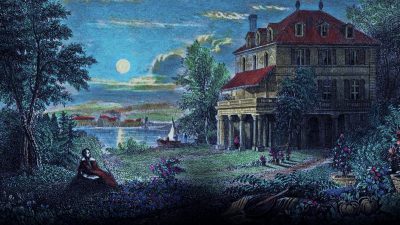
Villa Diodati, Geneva, Switzerland – the place where Frankenstein was “conceived”
The Birth of a Monster
Frankenstein first came to life in the highly unusual year of 1816 – also known as “The Year Without a Summer.” The massive eruption of Mount Tamboro, a volcano in Indonesia, blasted vast clouds of volcanic ash into the atmosphere, resulting in severe climate disruption around the world. Crops failed, and Europe, North America, and Asia were plagued with extreme cold and wet weather with torrential rains.
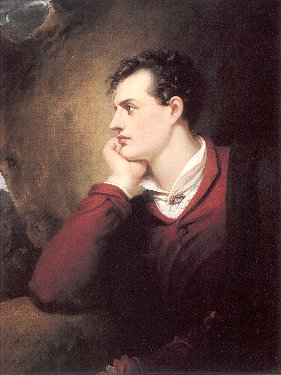
Lord Byron
The Shelleys were staying with their close friend, Lord Byron, her stepsister Claire Clairmont (who just happened to be carrying Byron’s illegitimate child), and Byron’s personal physician, John Polidori*.
It was because their planned pursuits of boating and picnicking on the lake were ruined by the relentless bad weather that Frankenstein first came to life on a rainy afternoon in 1816 in a rented villa on Lake Geneva in Switzerland.
To pass the time, the group read aloud from a book of German ghost stories. Byron then suggested they each write a Gothic ghost story of their own; Mary was the only one who actually completed the challenge, and she pursued the novel with the urging of her husband.
Mary attributed her inspiration for Frankenstein to a terrible nightmare induced by the scary stories told on that rainy day on Lake Geneva:
I saw the pale student of the unhallowed arts kneeling beside the thing he had put together. I saw the hideous phantasm of a man stretched out, and then, on the working of some powerful engine show signs of life and stir with an uneasy, half-vital motion …’
But scholars also believe that Mary’s nightmares about her lost first baby figured significantly in her imagination with fantasies of bringing the dead back to life. As she wrote in her journal in 1815:
“Dreamt that my little baby came to life again; that it had only been cold, and that we rubbed it before the fire, and it lived. Awake and find no baby. I think about the little thing all day.”
Or perhaps Mary’s near-constant state of pregnancy during those years turned her thoughts toward what it means to create life?
*****
Call it Karma… but despite their literary successes, bad luck continued to follow the Shelleys during and after the writing of Frankenstein.
In October 1816, Mary’s beloved half-sister, Fanny, committed suicide by overdosing on laudanum. Then just two months later, Shelley’s abandoned wife, Harriet, drowned herself in Serpentine Lake. Harriet’s death cleared the way for the Shelleys to finally marry, but her family sued (and won) to deny Shelley custody of his own children. Mary and Percy did however, eventually patch things up with the Godwins.
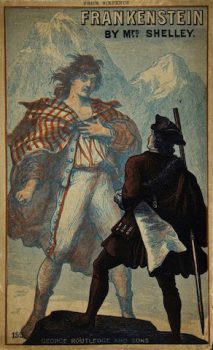
With her husband’s constant encouragement (and a little editing help), it took Mary about a year to complete the novel. Frankenstein was published in 1818 as a work by an anonymous author – few readers would believe a 21-year-old woman could imagine such a gruesome story. Most assumed that Percy Shelley had written it because he wrote the introduction. Frankenstein shocked and titillated the literary world; so needless to say, it became a best-seller.
Despite Mary’s literary triumph, and though Shelley came from a wealthy family, there was never enough money to pay the bills. The couple spent much of their time in Europe on the run from creditors.
And though Mary and Percy were devoted to each other, he was a terrible husband, unfaithful and careless. He and his circle of friends (especially notorious wild man Lord Byron) were believers in the Free Love Movement, but Mary was more conservative on this topic and refused to be “shared.”
Though adultery was a constant point of conflict in their five-year marriage, they suffered even more loss and heartbreak – two of Mary’s six pregnancies ended in miscarriage, and all but one of their four children died in infancy or early childhood. Even the birth of their youngest child, Percy Florence Shelley, the only one of their offspring to survive to adulthood, could not lift Mary’s deep depression. She was haunted by the memory of her lost children to the end of her days.
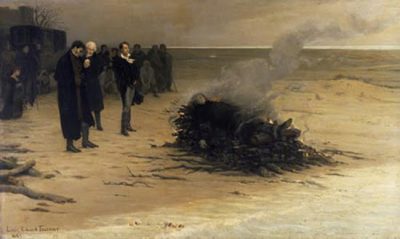
The Funeral of Shelley (1889) by Louis Fournier is a somewhat fanciful depiction of the cremation of Shelley’s body on the beach where it was found – a ceremony led by his best friend, Lord Byron.
Widowhood
Mary’s life was changed forever on July 8, 1822, with the death of her husband. Percy Shelley drowned when his ship sank in a storm while he was sailing with friends off the Italian coast. He was just a month shy of his thirtieth birthday. For over a week after he failed to return home, Mary waited, hoping for news of his rescue. Ten days later, his fate was confirmed when the bodies of Shelley and his companions washed up on the shore in such a state they could only be identified by their clothing.
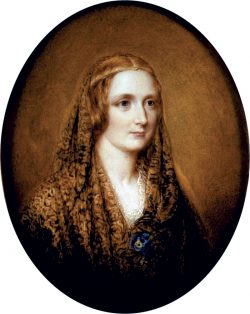 Shelley’s tragic death left Mary a 24-year-old impoverished widow and single mother. After her husband’s death, Mary dedicated herself to editing and promoting her husband’s literary legacy.
Mary and her son survived on a small stipend, grudgingly provided by her father-in-law, Lord Shelley. Percy’s works were were quite popular, and she herself was considered a successful writer during her lifetime. After her death, her writings fell out of fashion, and the only ones that are still widely read are Frankenstein and her journals.
Perhaps her own work would have been better known had she not devoted herself to her husband’s literary legacy instead of her own.
In the last decade of her life, Mary was plagued with poor health, but she spent her days writing and traveling with her beloved son (now Lord Shelley) and daughter-in-law. She died in London of brain cancer in 1851 at the age of 53 and was laid to rest with the cremated remains of Percy Shelley’s heart.
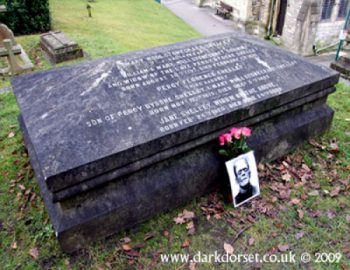
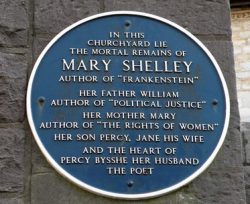
* Mary wasn’t the only one inspired during this all-star horror weekend – Two years later, John Polidori wrote the first English-language vampire story, The Vampyr (1819).
All I can say is Wow. This tragic tale certainly puts our own suffering in perspective. I hope she came back as a tranquil writer of happy little children’s stories or something. But thanks for the Monster.