

Celebrate Vincent’s 107th birthday with some of his classic performances!
“I sometimes feel that I’m impersonating the dark unconscious of the whole human race. I know this sounds sick, but I love it.” – Vincent Price
If any actor is the face of Gothic horror cinema, it has to be Vincent Price.
He began his career on the Broadway stage, and in his long career he appeared on stage and in over 100 films spanning multiple genres – film noir, mystery, thriller, drama, and even comedy – excelling in every one. (Seriously, anyone who can star in a movie called Dr. Goldfoot and the Bikini Machine has to have a great sense of humor.) Of course, it was his work in the horror genre that made him a superstar.
With his dashing good looks, elegant demeanor, and that mellifluous, unmistakable voice, he could easily have followed a different career path. But that wasn’t what he wanted.
His daughter, Victoria, wrote that he felt he found his niche in horror films because it gave him an opportunity to be a real character actor – he found playing good guys and romantic leads terribly boring. Instead, he sought out roles that allowed him to dig deep into the darker side of human nature. No one could convey sinister menace like Vincent.
Price was a real Renaissance man, a true lover of life. Not only was he a revered actor across multiple media (film, stage, TV, and radio), but he was also an esteemed art collector, author, gourmet cook, and travel expert.
Beloved by fans and colleagues alike, he had two stars on Hollywood Boulevard’s Walk of Fame (one for film, one for television), and both Tim Burton and John Waters named him as a role model… so as an admirer of Mr. Price, I think I’m in great company!
It was hard to narrow it down, but here are my Top Ten Favorite Vincent Price Horror films (in chronological order) in honor of his 107th birthday on May 27th.
*****
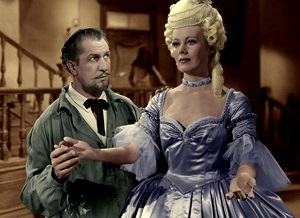 House of Wax (1953)
The film that made Vincent Price a bona fide horror star was House of Wax, the first color 3-D film released in America.
Price starred as Professor Henry Jarrod, proprietor of a wax museum filled with uncannily lifelike wax sculptures of famous/infamous historical figures – his “Marie Antoinette” was his pride and joy. When his greedy partner burns the place down (with him in it) for the insurance money, Jarrod survives, but resurfaces years later with a new museum… and a bad attitude!
Director Andre de Toth didn’t miss a single opportunity to exploit the 3-D gimmick, from a paddleball game to can-can dancers – despite the fact that he was blind in one eye and couldn’t see the effects himself).
He certainly brought out the best in his excellent cast, including Carolyn (Morticia Addams) Jones and a young Charles Bronson. The art direction and makeup are exceptional, especially the incredibly lifelike wax figures… almost TOO lifelike if you know what I mean.
What’s unique about this movie: Early 3-D effects and creepy melting wax faces.
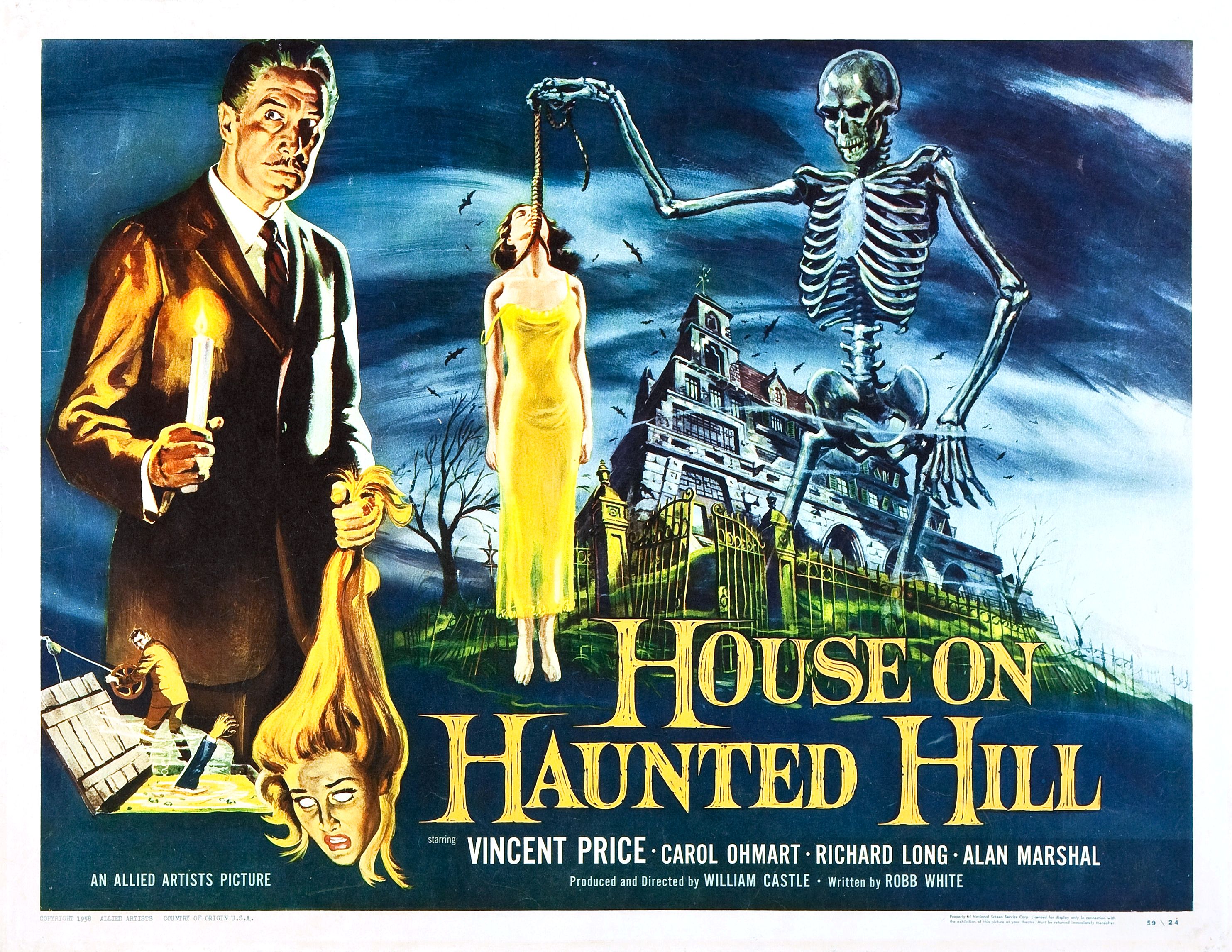 House on Haunted Hill (1959)
Vincent Price is delightful as an eccentric millionaire who offers ten thousand dollars to any one of five “guests” who can survive the night in his haunted house. What the guests don’t realize is that they’re not only trapped in there with each other but also with the ghosts of all the poor souls who died in that house – apparently quite a few, and always room for one more!
In the role that truly launched his horror career, his unique presence and acting talents really shine, with a glimpse of the real genre star he became in the 1960s and beyond. The film is dark and macabre with plenty of good creepy scares and surprises. Director/producer/master showman William Castle definitely knew how to keep an audience engaged and on the edge of their seats.
House on Haunted Hill is nonstop fun, with severed heads, acid pits, walking skeletons, secret passages, and more plot twists than you can shake a noose at.
The film was quite successful upon its release, especially with the help of Castle’s unique marketing gimmicks. So successful, in fact, that that it even inspired Hitchcock himself to take a shot at low-budget horror films.
What’s unique about this movie: Fourth-wall breaking and Castle’s legendary “Emergo” gimmick in which a glowing skeleton flies over the heads of theatergoers.
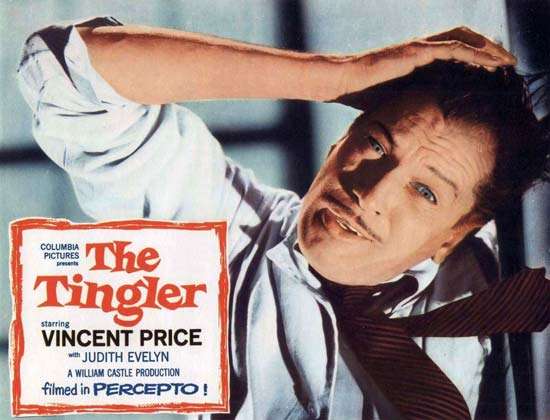 The Tingler (1959)
To be honest, I know this isn’t Citizen Kane (I did say these were my Favorites, not necessarily the best!), but it’s certainly a lot of fun to watch, and it did elicit a delightfully campy performance from Vincent – one of the most satisfying of his career.
In this film, Price plays Dr. Warren Chapin, a pathologist who discovers a parasite that lives within the human spine and feeds on fear. Screaming for your life is the only way to stop it! Dr. Chapin gets the chance to test his theories when he meets a deaf-mute woman who is unable to scream. With LSD on board to encourage hallucinations, Dr. Chapin volunteers for his own experiments.
We also have director William Castle (AKA the PT Barnum of Cinema) to thank for The Tingler. As mentioned above, Castle’s greatest claim to fame was his crazy marketing campaigns to sell his films and how far he would go to get butts in seats.
The Tingler was successful in part due to one of Castle’s greatest gimmicks – “Percepto!” A number of seats in the theater would be prewired to deliver an electrical buzzing vibration to the butt of the seat occupant. Then at a certain point in the film, Dr. Chapin bellows that the Tingler is loose in the theater, the seat buzzers are deployed, and Madness ensues.
What’s unique about this movie: This is also the only film that I’m aware of in which Vincent Price takes an acid trip.
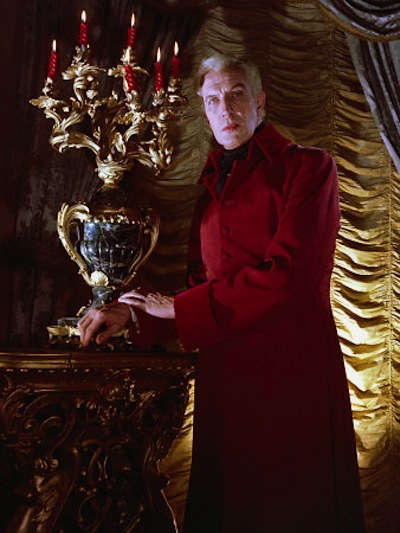 House of Usher (1960)
Director/producer Roger Corman is one of the most creative low-budget filmmakers in Hollywood history. House of Usher was the first film in a long and profitable Price/Corman partnership – a series of eight films based on the works of Poe, dubbed the “Poe Cycle.” (Vincent appeared in all but one.) The films are characterized by Gothic sets, haunting surrealistic dream sequences, overwrought dialogue… and often only a fleeting resemblance to Poe’s actual works.
In this first film of the series, Vincent stars as Roderick Usher, a tortured soul who is the last male descendant of a doomed aristocratic family rife with madness, disease, and overall bad luck. He lives with his sister Madeline in a decaying castle (of course), and his plan is for them to live out their days in seclusion there, putting an end to their accursed bloodline.
But when Madeline’s fiancé shows up at the House of Usher to get Roderick’s blessing for their marriage, the lengths Roderick will go to prevent the wedding become frighteningly apparent… including burying his sister alive. Vincent is superb in conveying well-intentioned madness, convinced that he’s doing the right thing, no matter how horrific.
What’s unique about this movie: We get to see what Vincent looks like as a blonde.
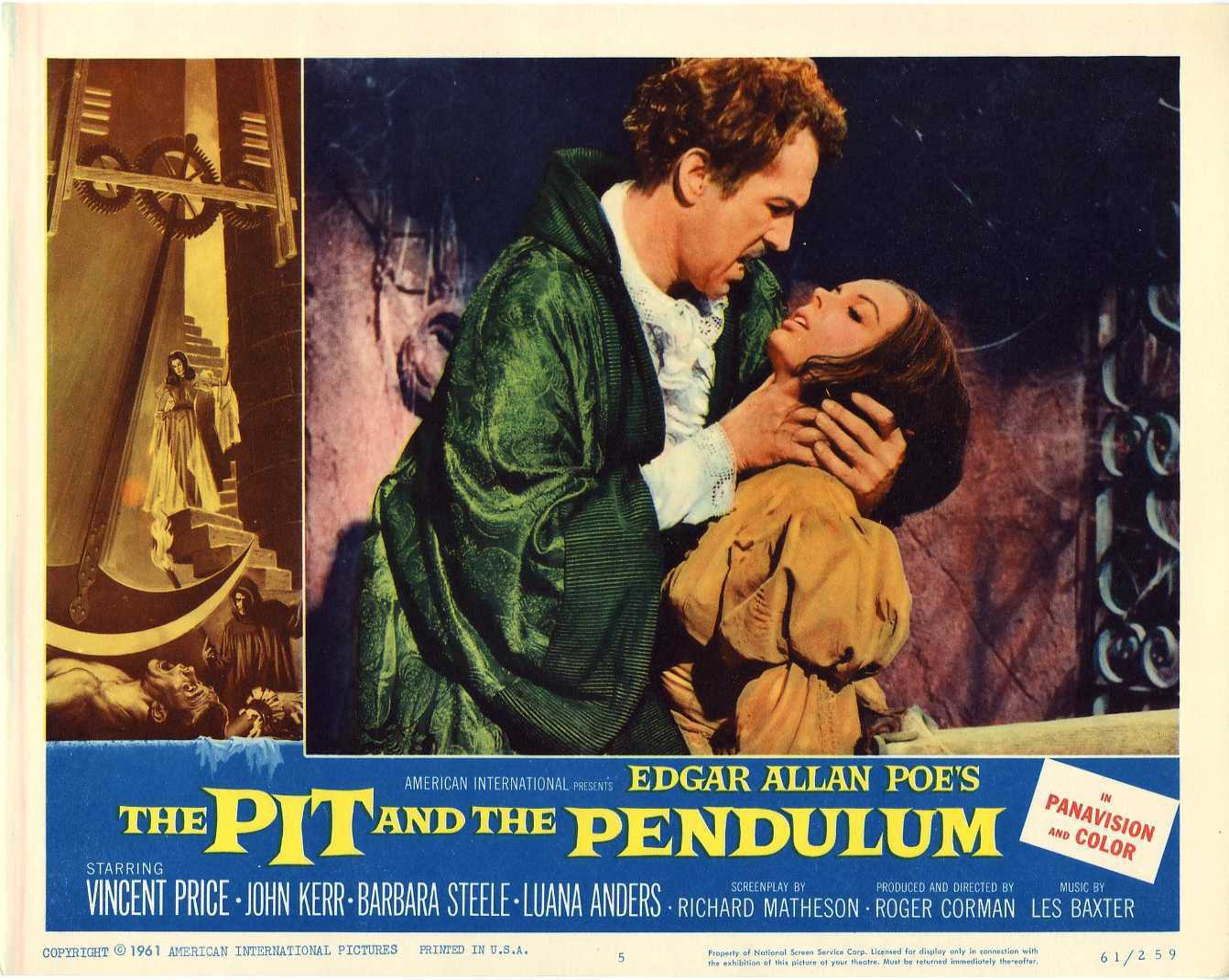 The Pit and the Pendulum (1961)
The second film in Corman’s Poe Cycle is set in 16th century Spain.
When Francis Bernard learns of the untimely death of his sister, he travels to the castle where she lived with her husband, Nicholas Medina (Price). But there’s something fishy about the brother-in-law’s story, and Bernard starts snooping around the castle to get to the bottom of the mystery. He’s shocked to find out that the grieving husband has a dark family history – he’s the son of the most notorious torturer of the Spanish Inquisition.
First, the performances are great – Price handles double duty as both the widowed husband, Nicholas Medina and his evil father, Sebastian. Barbara Steele, known for her work with Hammer Studios, plays the “late” Mrs. Medina. (Some of the more violent, disturbing scenes will also remind you of Hammer Studios classic horror films.)
Corman knew how to squeeze every dollar out of a bare-bones budget and still make a memorable film. The Pit and the Pendulum is classic Corman – Macabre color palettes with splashes of bright color (you can see this influence in Italian horror cinema later on), creative camera angles, and effective use of atmosphere to inspire a general sense of foreboding.
What’s unique about this movie: Vincent’s dual role. Screenplay by Richard Matheson, author of I Am Legend and many Twilight Zone episodes.
 The Masque of the Red Death (1964)
In this film – number seven of eight in the Poe Cycle – Vincent strikes just the right notes of malevolence and cruelty as an evil Satanist prince who terrorizes the peasants over whom he rules. As the Red Death plague rages through the village, Vincent’s despicable Prince Prospero spares a beautiful woman and her family, but only because he has the intention of corrupting her. He takes the family back to his castle, where he has also invited his jaded noble friends to shelter and wait out the plague.
The merrymakers in the castle figuratively fiddle while Rome burns. Then when Prospero throws a masked ball for the entertainment of his guests, he notices a stranger dressed all in red. He hopes it’s Satan (he’s a big fan)… but is it?
Roger Corman has declared The Masque of the Red Death to be one of his personal favorites among his films.
What’s unique about this movie: If you’re wondering why the sets are so much better than his usual productions, it’s because they were filmed on leftover sets from Becket (1964). It’s by far the most visually opulent of the Poe series.
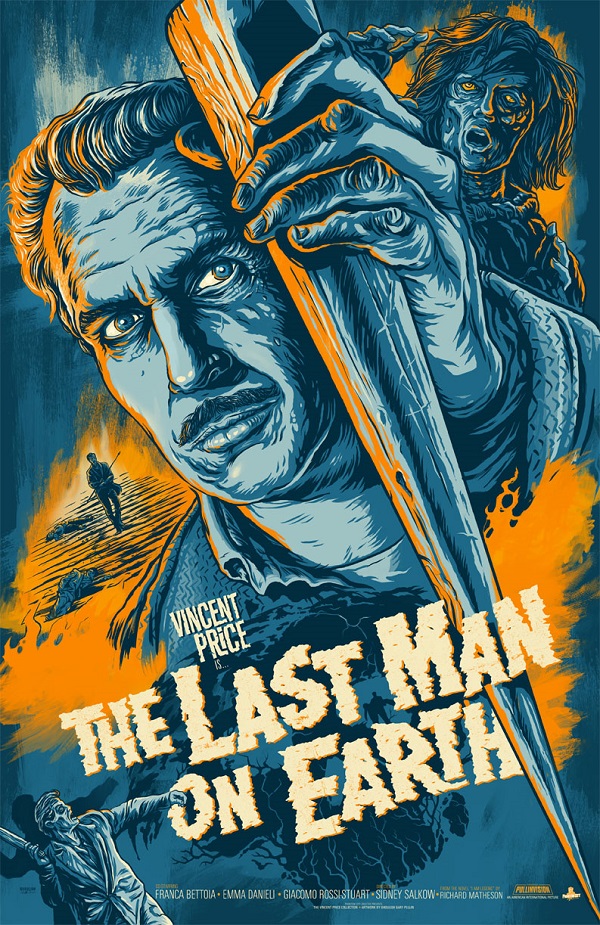 The Last Man on Earth (1964)
This 1964 film is based on Richard Matheson’s novel I Am Legend. It was originally meant to be directed by legendary German director Fritz Lang and produced by Hammer Studios in England.
Vincent plays Dr. Robert Morgan, sole survivor of a deadly plague that has killed most of the human race… except, of course, for the ones who turned into vampire-zombie creatures.
Barricaded in his fortress-like building, Morgan forces himself to follow a rigid daily routine in an attempt to get through the day with his sanity intact. Then at night, he becomes a reluctant vampire hunter as he tries desperately to find a cure.
In an exceptional performance, nearly silent except for the voiceover narration and the sounds of the undead, Price eloquently conveys Dr. Morgan’s pain and loneliness through gestures and facial expressions. He plays the role without his usual hammy gusto with the numbness and detachment you would expect for a survivor of the apocalypse.
Although the story is set in Los Angeles, the movie was an Italian production and was shot in Rome. This made for an interesting filming process. In an interview in Attack of the Monster Movie Makers, Vincent said, “if there’s a city in the world that doesn’t look like Los Angeles, it’s Rome. We would get up and drive out at five o’clock in the morning to beat the police and try to find something that didn’t look like Rome.”
What’s unique about this movie: If the plot of surviving the onslaught of the undead sounds familiar, that’s because it is. George Romero often cited The Last Man on Earth and Matheson’s original novel as his primary inspiration for Night of the Living Dead (1968).
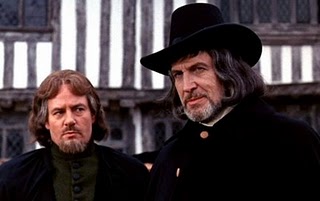 The Witchfinder General (1968)
(Released in the US as The Conqueror Worm – though it had nothing to do with the poem – to capitalize on the success of the Poe Cycle.)
One of Vincent’s greatest strengths was making the audience feel empathy for evil characters – or at least to understand why they were evil, or even perhaps to cheer them on in spite of it. However, his portrayal of a real-life 17th century witch hunter is an exception, and Vincent relished chewing the scenery as the most despicable character he had ever played.
The critically acclaimed film is the fictionalized story of former lawyer Matthew Hopkins who traveled around England in the 1640s, claiming to have been appointed by Parliament (probably not actually true) to purge the realm of witches. In other words, sanction to rape, torture, and kill men and especially women according to his whims.
There’s a shocking amount of violence and sadism for a film of its time. You won’t see the usual campy moments you expect from Vincent’s Corman and Castle films.
Director Matthew Reeves openly admitted that Price wasn’t his choice for the role, but the studio insisted as it had Vincent under contract. Reeves and Price frequently clashed on set. When Price finally saw the film after its release, he realized what Reeves was going for and was quick to apologize, Price sent Reeves a long letter praising the film and later stated that he considered it one of his best performances.
What’s unique about this movie: Unlike Vincent’s usual roles, the villain is entirely unsympathetic.
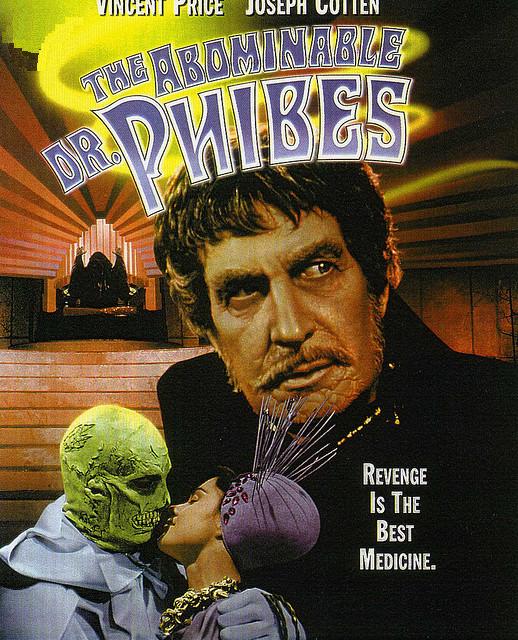
The Abominable Dr Phibes (1971)
In one of his most iconic roles ever, Price plays Dr. Anton Phibes, a horribly disfigured scholar and scientist. When his beloved wife dies during a botched surgery, he blames the negligent doctors and begins killing them off one by one through elaborate death scenarios based on the biblical plagues of Egypt – definitely some of the best, most creative murders you’ll ever see in a horror film.
Because Phibes is disfigured and unable to use his mouth, there’s greater emphasis on his amazing voice. He speaks through an electronic device with a creepy, disembodied voice that is vaguely unsettling. It’s also rather different from his usual campy portrayals, as he plays the role in a more serious manner.
Though Vincent’s brilliant performance is good enough reason to see Dr. Phibes, director Robert Fuest has created a unique movie experience. It might be described as almost an “anti-period” picture, mixing a 1920s aesthetic vision with the sensibilities of 1970s Mod style. The result is a unique world filled with fantastical machines, dark humor, a clockwork band and vibrant colors. And what’s up with Vulnavia, his mysterious silent assistant with a wardrobe that would make Cher jealous?
The producers must have been confident that Dr. Phibes would be a hit – the ending is a perfect set up for Dr. Phibes Rises Again in 1972.
What’s unique about this movie: Just about everything!
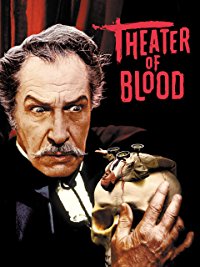
Theatre of Blood (1973)
Not just one of my favorite Price films, but both Vincent and the divine Diana Rigg considered it one of their best. The all-star cast really seemed to relish delivering the sometimes outrageous dialogue.
Vincent plays Edward Lionheart, one of the greatest Shakespearean actors of his time. Lionheart never received the recognition he rightly deserved, and the last straw comes when a circle of vicious critics snubs him for a prestigious acting award. After surviving a suicide attempt, he exacts a terrible revenge on the theater critics with the help of his loyal daughter.
You’ll recognize the basic narrative structure, of course, from Dr. Phibes. But while Phibes based his murder methods on the Egyptian plagues, Lionheart kills off his detractors with very creative methods inspired by Shakespeare’s plays. (For example, think Titus Andronicus…).
Again, Price does what he always did best – taking a villainous character and making him sympathetic, even with a touch of humor – until suddenly you realize you’ve been rooting for a murderer.
What’s unique about this movie: This is one of Price’s bloodiest films – over 6 gallons of stage blood were used in the production. The film was shot entirely on location – not a single soundstage was used.
Outstanding! I must get acquainted with more of these classic movies. Such an interesting man…