
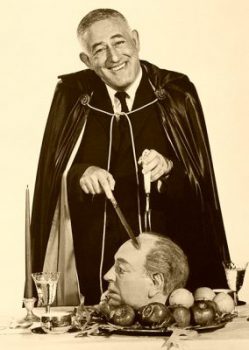
William Castle, having a friend for dinner
When I noted that producer/director William Castle (1914-1977), one of greatest showmen in Hollywood history, had a birthday this week, I was reminded of his countless over-the-top contributions to cinema culture.
He didn’t make a name for himself in the film industry by directing classic works of cinematic art. Hardly! Castle’s true genius was marketing. Like a 20th century PT Barnum, he was a master at filling theater seats with audiences who came to see “shock and schlock.” His movies delivered what audiences craved at that time – Horror, gore, suspense, and a heaping helping of camp.
And of course, the promotional gimmicks he used to sell his movies in and out of the theater have since become legendary. Even people who haven’t seen the movies often have heard about the gimmicks Castle used to sell them!
*****
The growing number of home television sets in postwar America (as well as a 1948 Supreme Court antitrust decision breaking up the big studio production-distribution monopoly) led to hard times for the film industry. For that reason, marketing became even more critical to a movie’s success.
Though horror movies were making big bucks on shoestring budgets in the 1950s, eventually competition and market saturation started to cut into profits. To attract bigger crowds, directors and studios had to get even more creative in differentiating their movies from everyone else’s – anything to get viewers flocking to theaters again. The secret sauce was to come up with something outrageous enough to make your movie stand out from the crowd.
Castle wasn’t the only director to try crazy stunts – inside the theater and elsewhere – to attract an audience, but he was certainly one of the most imaginative.
From vomit bags to colored glasses to evil hypnotists to fright insurance, here’s a list of my Top Ten favorite classic horror film gimmicks, more or less in chronological order.
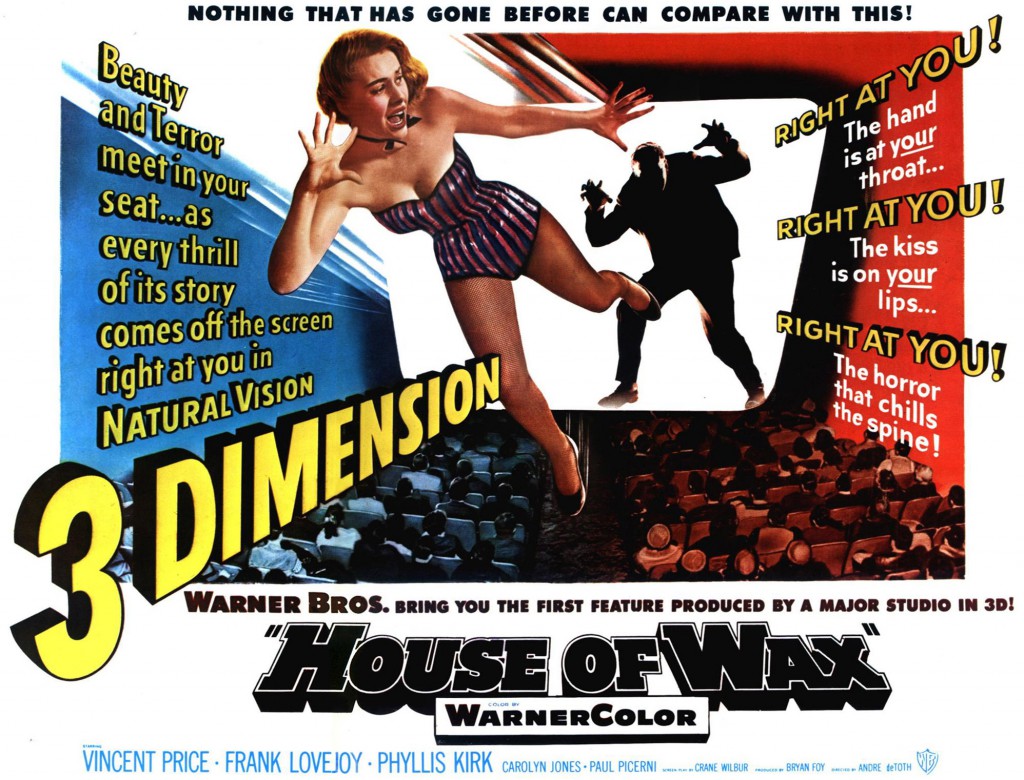
#10: Illusion-O and the Birth of 3D
First Seen In: Bwana Devil (1952), House of Wax (1953)
Though 3D movies have been around since the 1890s, Bwana Devil was the first full-color stereoscopic feature. But it was William Castle’s 1953 hit House of Wax that put 3D movies on the map – it was the first 3D film from a major studio to make the year’s Top 10 list, and it made Vincent Price a star.
Most 3D films of the 50s didn’t use the cheapo red-and-blue glasses to produce the effect. Theaters instead used a double projector system with two separate rolls of film (one for the right eye and one for the left), later enhanced with inventions like Edwin Land’s Polaroid filters. However, the two prints had to be perfectly synced for a clean projection, often resulting in alignment issues that induced headaches, particularly for audience members not sitting in the center of the auditorium.
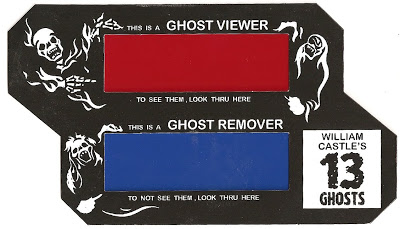 In 1960’s 13 Ghosts, Castle took 3D in an interesting direction with “Illusion-O” – basically your typical red-blue 3D cardboard glasses but with the colored filters stacked vertically instead of side-by-side. The film is presented in standard black and white until a ghost appears, at which point the users are prompted to use their Ghost Viewers. The red side makes the ghosts visible, while the blue side hides them for faint-hearted viewers. It didn’t work all that well – you could still see the ghosts albeit less clearly without the glasses, and looking through the lenses had little effect.
 #9: Psycho-Rama
First Seen In: My World Dies Screaming, aka Terror in the Haunted House (1958)
Psycho-Rama introduced audiences to subliminal imagery, used for the first time as a way to get into the audience’s heads the way traditional images couldn’t. Skulls, snakes, ghoulish faces, and the word “Death” (not to mention such pithy messages as “Die Die Die” and “Scream Louder!”) would flash on the screen for a fraction of a second—not long enough for a viewer to consciously notice it, but enough to be unsettling. Psycho-Rama never really caught on with the public or the film industry, but since then, other horror directors (for example, William Friedkin in The Exorcist) have used this technique to amp up the scares in their own movies.
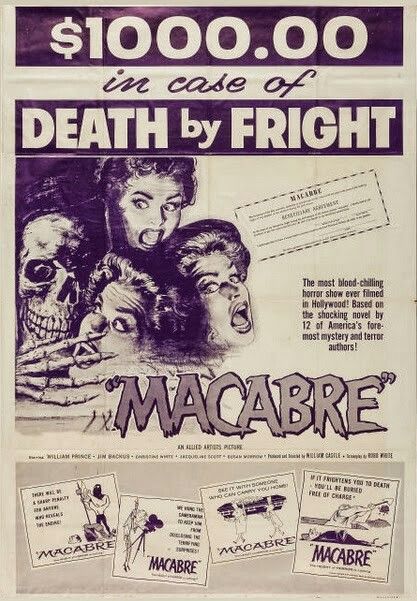
#8: “Death-By-Fright” Insurance
First Seen In: Macabre (1958)
This promotion was one of Castle’s most brilliant marketing stunts. Every moviegoer who purchased a ticket to Macabre received a certificate for a real life-insurance policy purchased by Castle from Lloyd’s of London. If you were to die of fright in the theater, your family would get a thousand bucks! At least if you couldn’t survive the frights, your family would get some cash. Unfortunately, your claim would be denied if you died of natural causes or suicide, which is only fair.
Cult director John Waters praised Castle’s marketing scheme for Macabre in his book, Crackpot:
“Mock insurance policies appeared in all the newspaper ads. Giant replicas of the actual policy hung over the marquees. Hearses were parked outside the theaters, and fake nurses in uniform were paid to stand around the lobbies.
“Audiences fell hook, line, and sinker. Nobody talked about the movie, but everyone was eager to see if some jerk would drop dead and collect. Of course, no one died. But if they had, it would have been even better. A death of any kind inside the theater would only have cost Lloyd’s of London a paltry $1000, and think of the hype that would have generated!”
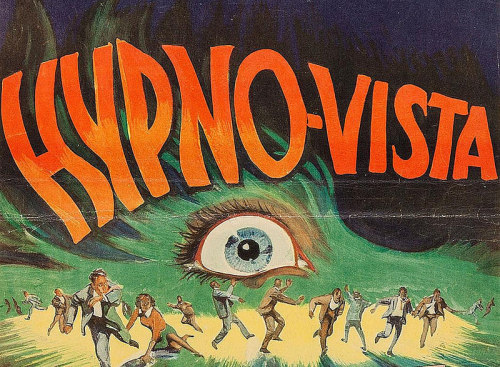 #7: Hypno-Vista
First Seen In: Horrors of the Black Museum (1959)
If you really, really want to make sure your audience is riveted on your movie, what can you do? You can hypnotize them! Horrors of the Black Museum was a movie about a killer hypnotist, and American International Pictures thought it would be a good idea to hype the movie with a lecture by a real hypnotist at the beginning.
For 13 minutes before the story began, Dr. Emile Franchel lectured about the science of hypnotism and even attempted to hypnotize the audience to get them more immersed in the story.
Sounds pretty dull, but it achieved its purpose of filling seats in theaters. In fact, this part was removed from the TV print of the movie because some viewers were in fact actually being hypnotized!
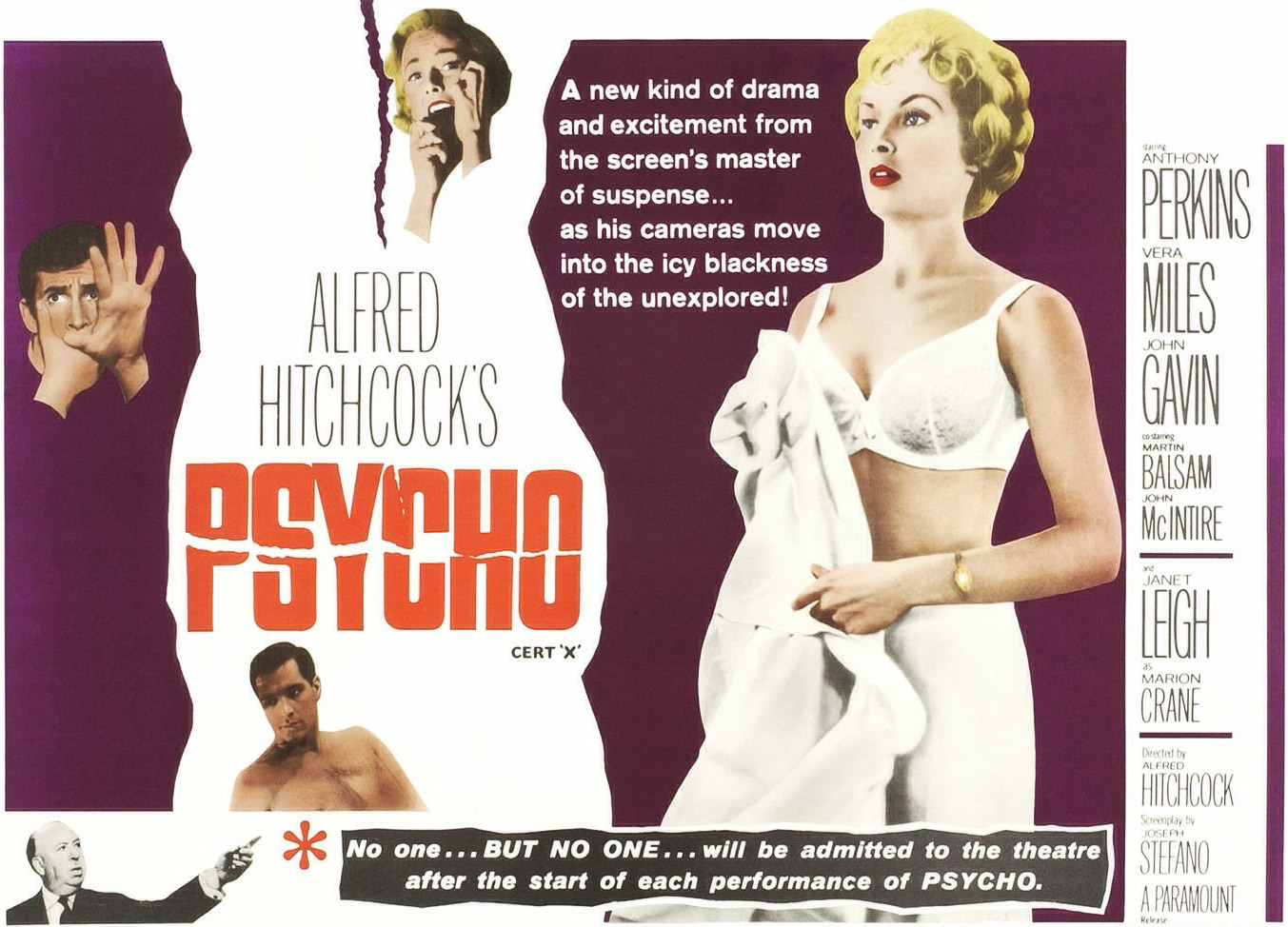 #6: No Late Admission
First Seen In: Les Diaboliques (1955), Psycho (1960)
Not exactly the gimmickiest gimmick out there, but Hitchcock’s insistence on no one being admitted after the movie started garnered a lot of publicity. (It was common practice in those days for people to show up in the middle of a movie and sit through a second showing.)
Hitch’s strategy, however, wasn’t so much to preserve the mounting sense of tension, but more for audience satisfaction. As Janet Leigh, the picture’s star, is dispatched a mere 47 minutes into the film, he was afraid audiences would feel cheated if they showed up to find the star was already dead. Again, other filmmakers used this gimmick later on to create a buzz about their films.
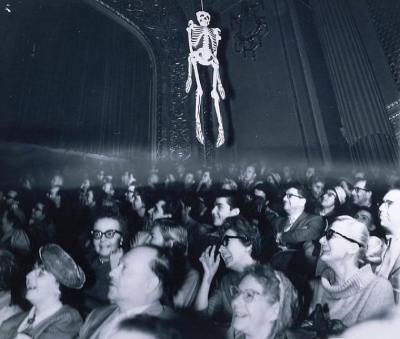 #5: Emerg-O
First Seen In: House on Haunted Hill (1959)
William Castle and star Vincent Price had a major hit with this film about an eccentric millionaire who offers strangers $10,000 to spend the night in his haunted house. Castle decided 3D wasn’t enough D’s, so he invented “Emerg-O.”
A special rig was set up in the theater, and at a certain moment in the film, a glowing skeleton would fly over the heads of the audience as the characters on the screen screamed in terror. In the huge movie palaces of old, the skeleton’s transit of the auditorium could take some time, and unfortunately once kids figured out what was going on, the poor skeleton would be pelted with popcorn, paper wads, and anything else they could get their hands on. So unfortunately, Emerg-O didn’t become a thing.
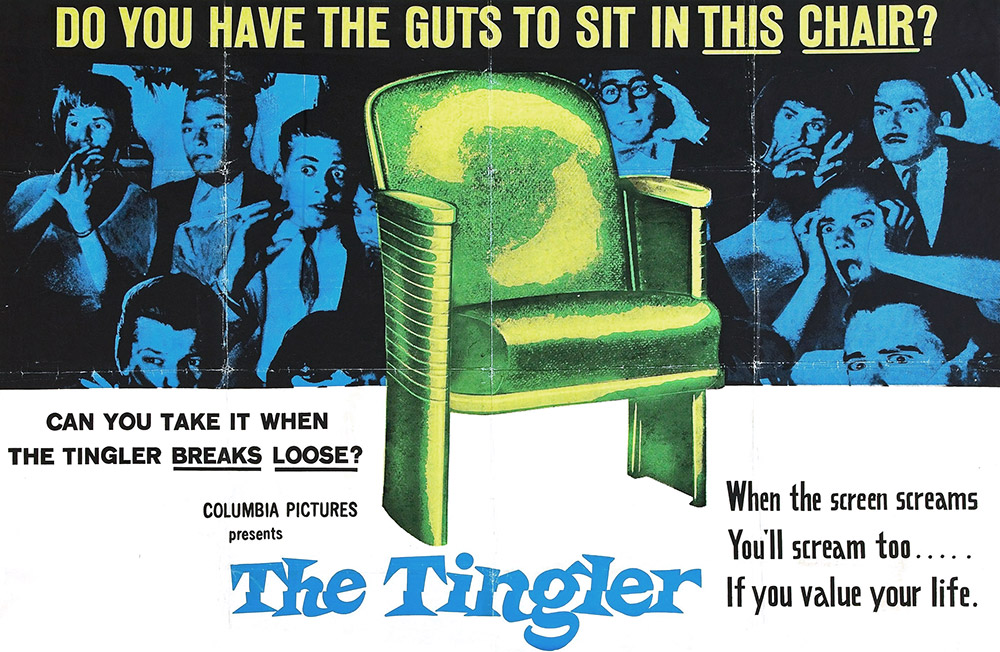 #4: Percepto
First Seen In: The Tingler (1959)
In the same year as House on Haunted Hill, Castle scored another hit with The Tingler, perhaps one of the all-time greatest horror films and the Mother of All Gimmick Movies. The premise of the film is that when you’re afraid, a foot-long centipede-like creature – The Tingler – grows in your spine. You can kill it by screaming your lungs out – but if you don’t (or can’t) scream… you die!
There were two parts to the Tingler gimmick: Covered cages or boxes were placed in the lobby, with mysterious and scary clicks and buzzes coming from inside (where presumably the Tingler is hidden). Would you be brave enough to sneak a peek?
But then came the genius part – a number of seats in the auditorium were rigged with vibrating buzzers that would go off during the film’s infamous finale, when Price would declare that “The Tingler is loose in the theater! … Scream! Scream for your lives!” The lights would go out, butts would be buzzed, and the entire theater would shriek in camp ecstasy.
 #3: Fright Break
First Seen In: Homicidal (1961)
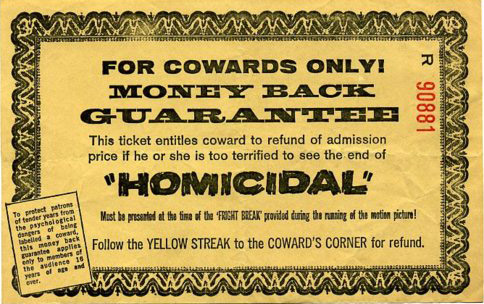
Another brilliant Castle gimmick was the Fright Break in Homicidal. Just as the movie was reaching its chilling climax, a timer would appear on the screen. Terrified audiences were informed that they had exactly 45 seconds to leave the theater and get a full refund… with one catch.
Chicken-hearted viewers were forced to sit in a yellow cardboard booth (guarded by an unfortunate theater employee) called the Coward’s Corner. They were then made to sign a paper declaring themselves to be “a bona fide coward” before they would get their refund.
Rather than be subjected to such humiliation, most viewers, no matter how spooked, chose to grit their teeth and take their lumps. Perhaps they should have taken out a Macabre Lloyd’s of London insurance policy?
 #2: Punishment Poll
First Seen In: Mr. Sardonicus (1961)
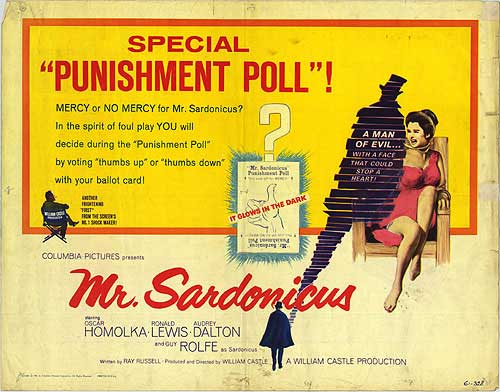
This Castle gimmick was interactive, putting the fate of the characters into the hands of the audience. Upon entering the theater, moviegoers were given a card with a picture of a glowing thumb on it.
When the time came, viewers were asked to vote – Thumbs up meant mercy for Mr. Sardonicus, while thumbs down… well, you know what that means.
Castle claimed he had filmed two endings, and the audience would get the outcome they voted for. However, no one ever saw the happier ending, and there’s no proof that it actually existed. Which is okay, because audiences never voted for mercy for poor Mr. Sardonicus anyway.
#1: Free Vomit Bags!
First Seen In: Mark of the Devil (1970)
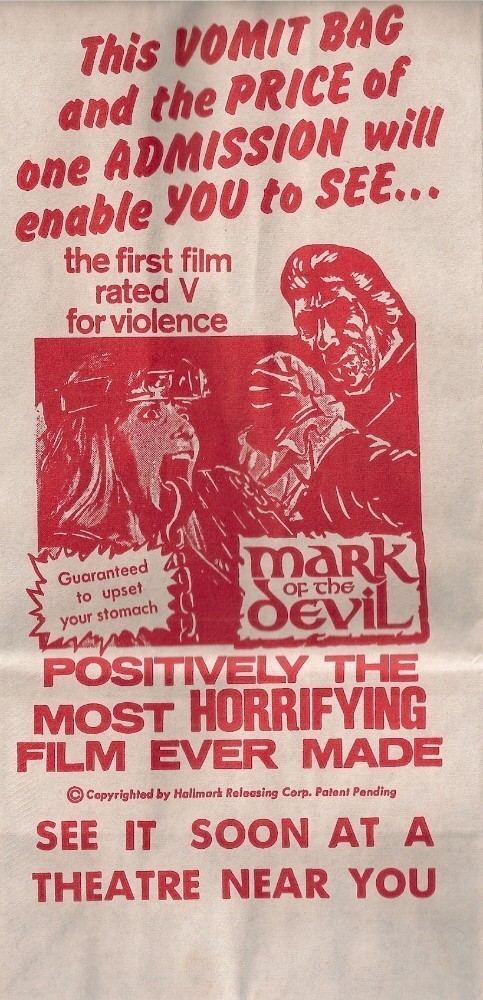
The makers of Mark of the Devil liked to say it was “rated V for Violence.” And also apparently V for Vomit. In an act of pure genius marketing, every audience member was issued a free vomit bag, presumably to protect the theater’s upholstery and carpeting. Posters for the film warned that Mark of the Devil was “guaranteed to upset your stomach!”
This, of course, was taken by true horror fans as a personal challenge. We horror fans like to think we’re pretty hardcore, so how could we resist proving our mettle in the face of gruesome torture and mutilation by resisting the urge to puke? The concept proved quite effective, as demonstrated by the movie’s killer box office numbers!
Note: I actually saw this one myself with a group of friends when we were in fifth grade (I can’t believe they let us in!). I kept my souvenir barf bag for many years. (Yes, it was empty…)
*****
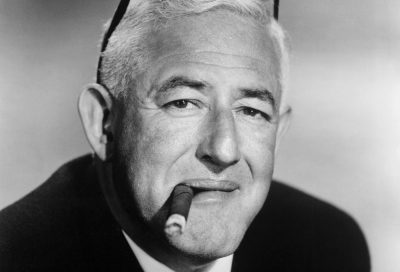
So in honor of his 104th birthday, I officially declare this week to be “William Castle Week!” I’ll be celebrating by firing up the DVD player and putting on my copy of The Tingler. Then I’ll set my phone to vibrate and put it in my back pocket – the closest you can get nowadays to the Percepto Experience!
What a wonderful article. I love your historical observations. Some day, some wealthy eccentric should put together a 10-day film fest of these very films, repeating their gimmicks as closely as possible. A Woodstock for horror fans old and new!