

Director: Mervyn LeRoy
Stars: Nancy Kelly, Patty McCormack, Henry Jones
Snack Report: The Last of the Utz Cheese Balls
There’s something I find especially terrifying about movies with murderous children. Just about a week ago, we had a zombie toddler wreaking havoc in Maine. Tonight the death-dealing tyke is a cute blonde, blue-eyed little girl with a beautiful smile, perfect manners… and who swings a mean pair of shoes.
We’re more familiar with sociopathy today than we were back then. We’ve seen enough in the news, movies, and TV about individuals with no sense of right and wrong and no empathy for others. And sweet little Rhoda Penmark is a textbook example of a remorseless sociopath.
Of course, The Bad Seed takes place in the 50s, when well-brought-up children were expected to be a lot politer than they are today. But Rhoda is perfect – TOO perfect – until we notice the cracks in her façade.
*****
[Spoilers ahead!]
On the surface, the Penmark family is a mid-century ideal: Handsome military officer Colonel Penmark (William Hopper), his beautiful wife Christine (Nancy Kelly), and their adorable 8-year-old daughter, Rhoda (Patty McCormack).
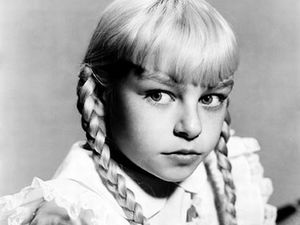
Despite our first impression, we see that Rhoda’s sweet nature and impeccable manners are also just part of the surface illusion. In reality, she’s a cold, calculating, greedy child, willing to do whatever it takes to get what she thinks she deserves. For example, she’s seething over a school penmanship medal, insisting that it should have been awarded to her.
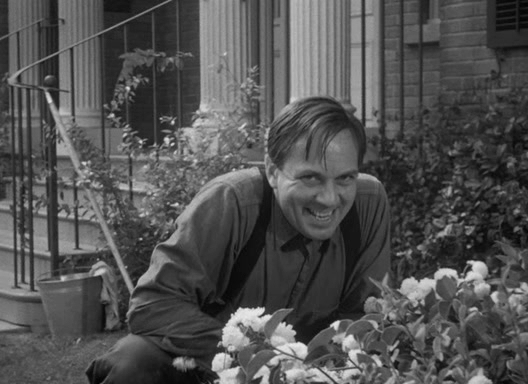
It doesn’t help that she’s spoiled rotten by their lonely landlady, Mrs. Breedlove. The only adult who doesn’t buy what Rhoda’s selling is Leroy the handyman (brilliantly portrayed by Henry Jones). Though he’s an adult, he doesn’t seem to be quite right in the head, and he constantly challenges and provokes Rhoda.
On the day of a school picnic, Rhoda shows off her shoes, which have recently been fitted with steel taps. Christine asks Rhoda’s teacher, Miss Fern, about how she’s getting along with the other kids, and Miss Fern promptly clams up.
Later in the day, it’s learned that Claude Daigle, Rhoda’s classmate who won the penmanship medal, drowned during the picnic. But when Rhoda returns home, she seems strangely unperturbed by his death and acts as if nothing has happened. Leroy takes note of this and senses that something (besides Claude) is fishy.
A few days later, Miss Fern returns to the Penmark apartment with some disturbing news. They’re pretty sure Rhoda was the last to see Claude alive, and she had been seen harassing Claude all morning about the medal. She doesn’t come out and say she suspects Rhoda was involved in his death, but it’s certainly implied. Also, Rhoda will not be welcome back at school in the fall – she has alienated all her classmates with her antisocial behavior.
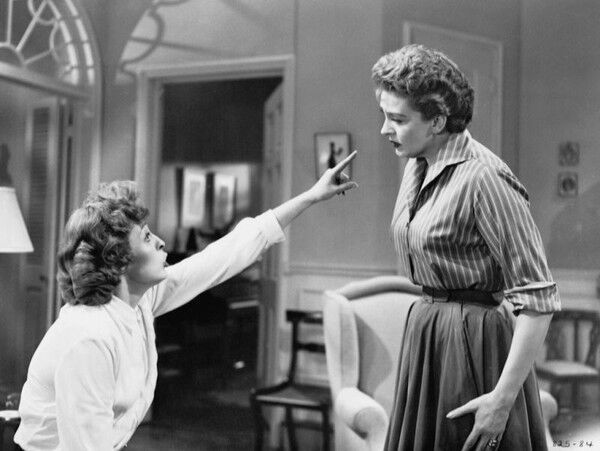 Their conversation is interrupted by the arrival of Mrs. Daigle (Eileen Heckart, in my opinion the best performance in the film), Claude’s drunken, grieving mother. After a bit of complete social inappropriateness, she comes to the point: She wants to know what became of Claude’s penmanship medal, and what Miss Fern is hiding.
Christine’s determination to trust Rhoda is shaken when she discovers the medal hidden in Rhoda’s room. Rhoda tries out a number of tactics, first denial, then trying a little flattery, and then a few lies that don’t work. Finally she begs her mother not to return the medal, insisting that she earned it. Christine relents.
Leroy takes advantage of the situation to get the advantage over Rhoda, telling her he knows all about how she killed Claude with a stick (actually, she used her shoe). He threatens to inform on her and even tells her about the little pink electric chairs they use on little girl murderers. She’s not afraid of Leroy, but you can tell she’s a little shaken.
Christine pretends she’s writing a murder mystery novel and asks a prominent psychologist about killer children. Can kids be born evil? (Take it from me, they can.) He agrees that there may be a genetic predisposition toward violence and murder – the theory of The Bad Seed. Such children seem perfectly normal on the outside, but…
Christine’s dad, a true crime novelist, joins them and argues the opposite point of view. Later he admits to Christine that her biological mother was a notorious serial killer! Now she’s terrified that she has passed on this mutant gene to Rhoda.
Meanwhile, Leroy foolishly continues to taunt Rhoda. He goads her until he realizes that she killed Claude by hitting him with her steel-reinforced shoes. He pushes her too far, and she loses her icy demeanor and shows the rage underneath. Leroy realizes too late that this is no longer a game, and Rhoda is someone he shouldn’t have messed with.
Mrs. Daigle staggers in again, but this time she’s drunk AND mad. She demands to confront Rhoda, certain that Rhoda knows more about Claude’s death than she’s telling.
Christine is becoming increasingly distraught, and Monica offers her sleeping pills. Their conversation is interrupted by horrible screams coming from the basement. Leroy is trapped inside, burning to death, as Rhoda claims another victim.
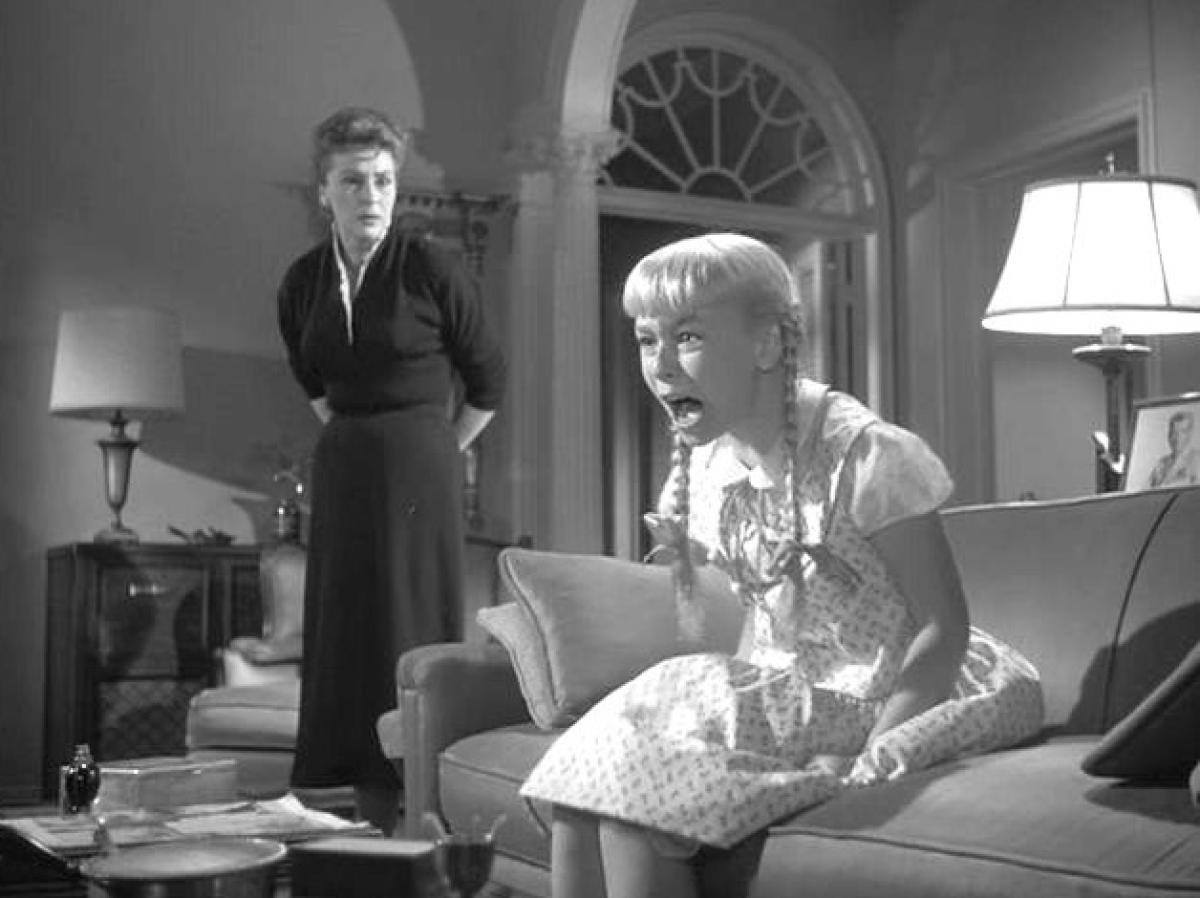
Christine breaks down, now convinced that she has passed on the murder gene to her daughter. Later, she gets Rhoda to confess to killing Leroy, insisting it was his fault – he shouldn’t have tried to scare her with talk of bloodhounds, police, and tiny electric chairs. When she asks her mother about the medal, Christine tells her she dropped it into the lake next to the pier where Claude drowned.
Christine now knows what she has to do. She gives Rhoda an overdose of sleeping pills and then shoots herself in the head.
As Col. Penmark, Mrs. Breedlove, and Christine’s father wait anxiously in the hospital, there’s great news – Rhoda will make a full recovery! Christine… maybe.
After being tucked into bed by her loving dad, Rhoda dons her raincoat, sneaks out, and makes a beeline for the lake to recover the medal. She spots it with her flashlight and gets a net to fish it out when…
BLAMMO!
A bolt of lightning vaporizes the little monster, and that’s The End.
But wait! There’s more!
In the original ending of the play, Rhoda survives and Christine dies. The puritanical Motion Picture Code enforced their rule that evildoers could never appear to get away with their crimes. So instead, Christine survives her suicide attempt, while Rhoda is wiped out by the bolt of lightning as she searches for the stolen medal.
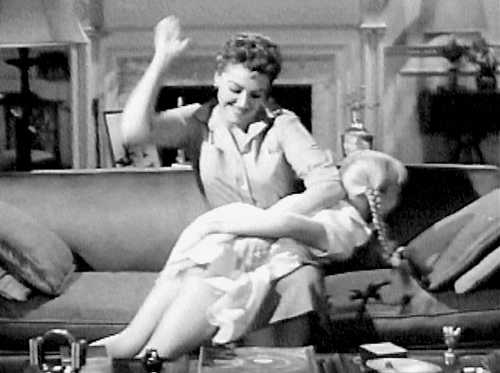
According to Patty McCormack, the weird “curtain call” epilogue is a holdover from the Broadway production. Apparently audiences were outraged by the original ending and left the theater angry. The epilogue is there to show reassure the audience that everyone is alive and well, and Rhoda pays for her crimes by getting a spanking (for being a murderer?).
The theory of “The Bad Seed” – that evil traits can be passed genetically from parent to child – isn’t new. Fortunately, real life pre-teen killers are few and far between. Hollywood just hasn’t figured that out yet.
*****
Here’s some Bad Seed trivia:
- Alfred Hitchcock was offered the opportunity to direct but turned it down.
- Warner Bros. production notes for the film reported that three potential endings were shot and kept secret. The last five pages of the script were not distributed until the time of the shoot.
- Bette Davis was interested in the part of Christine Penmark, but LeRoy insisted on giving it to Nancy Kelly, who won a Tony for the role on Broadway.
- The song that Rhoda plays on the piano and sings throughout is “Au Clair de Lune,” a traditional French children’s tune.