

Director: Jacques Tourneur
Stars: Frances Dee, Tom Conway, James Ellison
Snack Report: Utz Cheese Balls
Viewing Companions: Zelda and Mr. Falbeaux (both asleep)
For years, my son the Film Studies major has been singing the praises of underappreciated Russian-born Hollywood producer Val Lewton. I was already somewhat familiar with his body of work as a director, writer, and producer – I’ve seen Cat People (1942), Curse of the Cat People (1944), and Isle of the Dead (1945). Alex, however, was especially keen on getting my take on I Walked With a Zombie (1943).
I had planned this movie for an earlier screening, but we had to go with Plan B that night because of technical difficulties with the DVD. Lucky for us, Turner Classic Movies aired it this week, so we were finally able to watch this unique film. (Just for the fun of it, we made it a double feature with The Body Snatcher (1945).)
So let’s get this out of the way up front… If you read the title and were expecting flesh-eating monsters and buckets of gore, you will certainly be disappointed. The zombies in this film are the original old-school Caribbean kind, former people who are neither living nor dead, controlled by voodoo. Mostly, they just shamble around blank-eyed or stand there guarding things.
When Lewton took over as head of RKO’s horror film unit in 1942, the studio was in severe financial trouble. The decision was made to go for “Showmanship over Genius,” and Lewton was given three simple directives:
One – No budget over $150,000 would be approved.
Two – All films must clock in at 75 minutes or less.
Three – He would be supplied with a title and expected to build a film around it.
And somehow within these confines, he managed to succeed.
That’s basically what happened with I Walked With a Zombie. The studio was inspired by an article in American Weekly Magazine by that title, but Lewton hated the idea. In the end, he turned it into something more like “Jane Eyre of the Caribbean” and threw in a voodoo theme for good measure.
Director Jacques Tourneur, who collaborated with Lewton on several films, does what he does best, crafting a one-of-a-kind noir-ish horror film with visionary art direction and cinematography. With the underlying tension constantly ratcheted up by the relentless jungle drums, the combination is less terrifying than unnerving, more haunting than scary.
So how do we get from Jane Eyre to walking with zombies? (Pride and Prejudice and Zombies didn’t come along until 2016.)
With visions of palm trees and sandy beaches dancing in her head, pretty Canadian nurse Betsy can’t resist accepting a private gig in the Caribbean. She’s even happier when she arrives on the mysterious island of Saint Sebastian and finds out she’ll be living on a lush sugar plantation owned by two good-looking brothers! Her patient is Jessica Holland, the semi-comatose wife of the older brother. Jessica has been in a zombie-like state since a fever a couple years ago…perhaps the victim of a voodoo curse?
It’s not long before the skeletons start to emerge from the Holland family closet. Betsy just wants to help, of course, but then once she starts digging, she can’t stop, and she turns to the local voodoo cult to find help for Jessica’s condition.
Is the magic real? Or is it just hysteria? Is there a rational, scientific explanation for the events that take place? It’s never really clear.
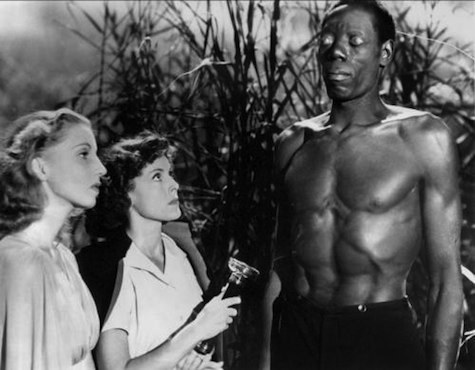
Superstition and guilt hang heavily over the island, and images of death and darkness abound. As Betsy leads Jessica through the shadowy sugar cane fields to the voodoo ceremony at the Houmfort, they encounter a number of disturbing sights. Dead animals are hanging from trees, skulls and bones on the ground. Perhaps the most unsettling figure of all is Carrefour, the otherworldly Zombie Guardian and minion of the voodoo priest.
Carrefour is the closest thing in the film to what we have come to expect from a zombie. So how did we get from Carrefour to the present-day Romero-type monster? (Note that the word zombie is never used in Night of the Living Dead (1968)).
Here’s one explanation that’s out there: The “original” zombies – lost souls neither living or dead, yet under the control of another – are an uncomfortable reminder of the Caribbean’s colonial history of enslavement and dehumanization that built those plantations and the sugar industry on the backs of native and African people. Maybe it was easier to turn the zombie into just another implacable brain-eating monster than to acknowledge it as a representation of oppression and human suffering.
I think it’s an interesting theory, certainly providing food for thought for fans of the zombie subgenre.
I Walked With a Zombie isn’t your garden-variety Living Dead gorefest. It’s quite a departure from the other films I’m watching this month, but I’m glad I took Alex’s advice and checked it out.