

Scene from The Terror – AMC
Imagine being trapped in a sea of ice… day after day of bitter, relentless cold… plagued by starvation and illness, with essentially no hope of rescue. Worse yet, knowing that the mission that brought you here was probably a bad idea in the first place.
The premise of Ridley Scott’s AMC series, The Terror, is certainly the stuff of nightmares.
The Terror was inspired by the true story of the doomed Franklin Expedition that set sail in 1845 in search of the Northwest Passage. The series is remarkably faithful to what really happened, while it also takes the tragic true story one step beyond into the supernatural realm by adding a giant man-eating Inuit ice monster to the cast.
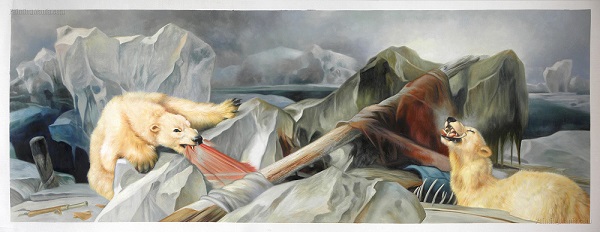
AMC’s series is based on the 2007 novel by Dan Simmons, but there have been other dramatizations of the story. Previous treatments include a play produced by Charles Dickens (who also acted in it!), an adventure novel by Jules Verne, The Rifles by William T. Vollmann, and some famous paintings like the delightfully gruesome “Man Proposes, God Disposes” by Edwin Henry Landseer, where polar bears are enthusiastically chowing down on what’s left of the ships and their crews. (Wouldn’t it be cool to have this hanging in your dining room?)
AMC’s The Terror, however, is the first adaptation that reimagines the tragic tale of the doomed expedition as a modern monster tale.

Ancient geographers proposed the existence of the Northwest Passage as far back as the second century AD. But it wasn’t until the Ottoman Empire monopolized all the major trade routes between Europe and Asia that finding an alternate sea route became a priority for the Europeans. The Northwest Passage, a navigable shortcut from the North Atlantic to the Pacific Ocean, seemed like the perfect solution to that problem.
Simple enough, right?
Not exactly. It would have been challenging enough to find a path through the labyrinth of islands and waterways of Northern Canada, but imagine trying to navigate between 300-foot icebergs and massive floes of sea ice that made progress impossible, even trapping and crushing ships unfortunate enough to be caught in them.
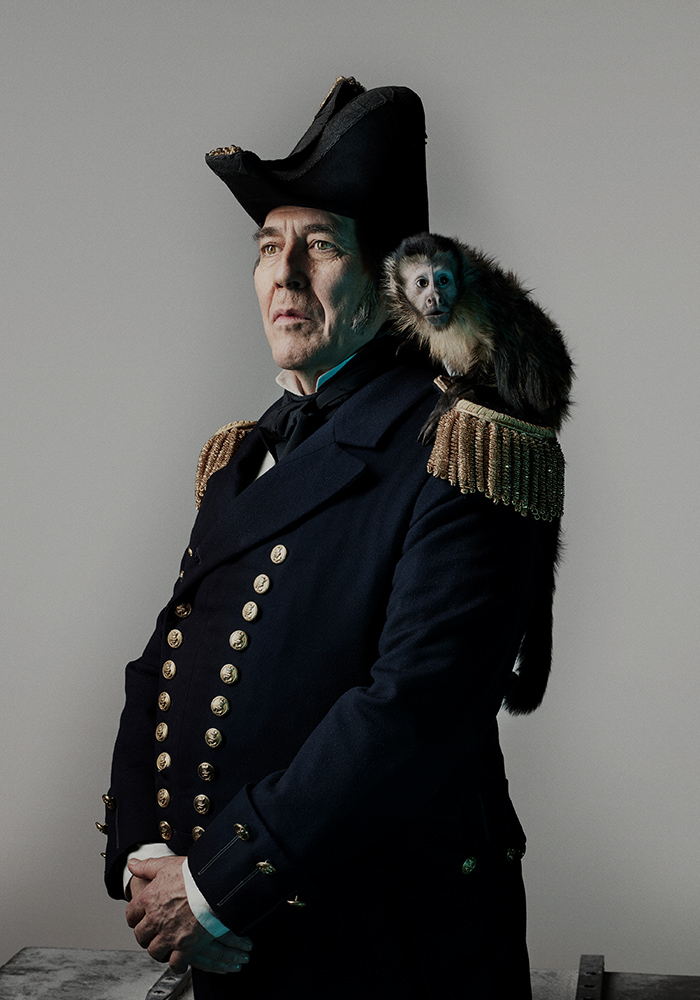
Ciaran Hinds as Sir John Franklin
There had already been a number of failed (read: usually fatal) expeditions to discover the Northwest Passage when Sir John Franklin set forth from England with 128 men on the Royal Navy HMS Terror and HMS Erebus on May 19, 1845. (Erebus was the personification of darkness in Greek mythology and a region of Hades. Could they have picked any more ominous names?)
Terror and Erebus were last spotted by European whaling ships in Baffin Bay (between Greenland and Canada) in July 1845, where they waited for the melting of the winter ice, hoping for a clearer path to the Pacific. The whalers were the last to see them alive before both ships vanished without a trace.
Though many had failed at the same mission, it would seem that Franklin’s expedition stood a better chance than most. Both ships were technologically advanced for their time, with steel-reinforced hulls, retractable iron rudders, and steam-powered propellers. They were well suited for extreme conditions – in fact, they were built to withstand mortar bombardment.
Franklin himself was a seasoned cold-weather explorer with three previous Arctic expeditions under his belt. The crews had three years’ worth of provisions, including nearly 100,000 pounds of meat, much of it in tin cans – the latest in food preservation technology. They had even brought along a 2400-volume library and a daguerreotype machine.

Jared Harris as Francis Crozier
With Franklin captaining Erebus, Francis Crozier (played in the series by Jared Harris) was put in charge of the Terror, which he had captained in the past on an Antarctic expedition.
After waiting out the winter, Franklin’s ships sought the Northwest Passage by sailing down the west coast of King William Island. In September 1846, the Erebus and the Terror became trapped in the ice. With three years worth of provisions, they were prepared to wait through the winter. But then in 1847, the ice never thawed.
After spending a second icebound winter, as starvation and disease took their toll, the crews of Erebus and Terror abandoned their immobilized ships in April 1848. They set out across King William Island, pulling their supplies and several small boats by sled across the ice. Unfortunately, there was no help to be found, and there were no survivors.
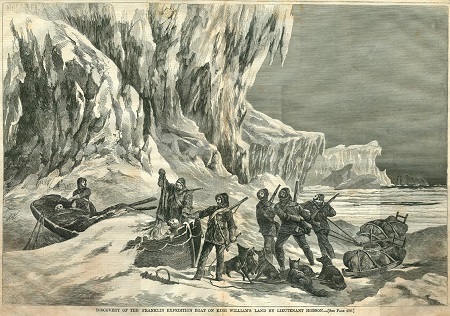
Nine years and many rescue attempts later, Scottish explorer John Rae purchased some of the expedition’s silverware from an Inuit who said a party of 35 or 40 white men had starved to death near the mouth of the Back River, in a region of the Arctic Ocean studded with barren islands separated by ice-choked passages.
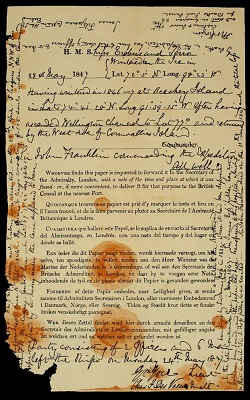
The crew’s last written message
Later expeditions found traces of Franklin’s party, including human remains and some written accounts of the crew’s fate. A final message on April 25, 1848, reported that Franklin had died aboard the Terror in June of 1847, and that the men who were still alive decided that their only option was to travel south on foot.
The frigid journey proved too difficult, and the condition of the remains that were later found provided undeniable evidence that the survivors resorted to cannibalism to stay alive. “Pot-polished” and cracked bones were found that were typical of what’s referred to as end-stage survival cannibalism, where bones are boiled for their marrow.
But beyond the gruesome evidence of the crew’s desperation, archaeologists found an unexpected impediment to the men’s progress across King William Island. Lead poisoning – which can often lead to madness – was also a factor in the crews’ demise. They were probably slowly poisoned by contamination of their drinking water from the lead pipes of the ship’s unique water filtration systems, as well as lead solder from primitive food cans leaching into the food supply.
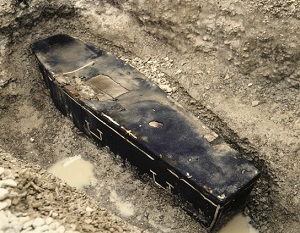
Despite numerous expeditions sent out to look for Franklin and the crews of Erebus and Terror, the remains of the two ships weren’t found for more than 150 years. Several years after Simmons’ novel was published, archaeological expeditions discovered the remains of crewmen who had died before the ships were abandoned, which offered more insights into the true story of the Franklin Expedition.

The bodies were in astonishingly good condition thanks to the permanently frozen turf they were buried in. No traces of monster activity were found, and it’s believed that a combination of exposure, starvation, and disease (including scurvy, tuberculosis, and pneumonia) killed the crewmen.
As for the ships themselves, Inuit testimony gathered in the 19th century was very helpful in narrowing down the search area and discovering their final resting places. Erebus was discovered in 2014 by the Parks Canada Agency and Terror two years later by the Arctic Research Foundation.
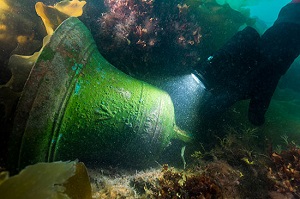
Erebus – ship’s bell
In light of the most recent discoveries, parts of the AMC series had to be rewritten to reflect new information about the true fate of the ships and their crews. In the original storyline, the Terror was torn apart by the raging ice monster. However, in 2016 the Terror was found completely intact at the bottom of an Arctic bay, so it turns out that monsters were probably wrongfully accused.
*****
Despite heroic efforts and loss of life and ships, a commercially viable Northwest Passage wasn’t found for nearly 60 years after the tragedy of the Franklin Expedition. Famous polar explorer Roald Amundsen led the first expedition to successfully navigate the Northwest Passage by sea in 1906. There had been a few dozen crossings since that time; nonetheless, the route was never really used much because of the massive amounts of sea ice.
However, there’s good news and bad news. The bad news is that climate change has resulted in a vast melting of Arctic ice, with dire consequences sure to follow. The good news is, however, that in 2007, the Northwest Passage was found to be ice-free for the first time in recorded history.
In fact, the luxury cruise ship Crystal Serenity made headlines in 2016 as the first passenger ship to traverse the Northwest Passage. So if you’ve got about $15,000 to spend, you too can explore the no-longer-so-treacherous Northwest Passage on your own.
But just in case… watch out for monsters!