

After 80 years of resting in relative peace, Friedrich Wilhelm (FW) Murnau, the acclaimed director who brought Nosferatu to life, made the news once again in 2015 when grave robbers broke into his tomb and stole his head.
After his untimely death in a 1931 car crash, Murnau was interred in his family plot in a cemetery in Stahnsdorf near Berlin. The perpetrators went to great lengths to break into Murnau’s metal coffin, decapitate his corpse, and make off with his skull. Police believed that they wanted it for an occult ritual, as a waxy substance found around the gravesite implied that candles had been burned there.
The adjacent graves of his two brothers were left intact.
It wasn’t the first time Murnau’s grave had been disturbed, and the cemetery is considering permanently sealing the gravesite. The current whereabouts of Murnau’s skull are as yet unknown.
*****
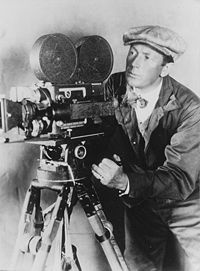
Murnau was born 129 years ago last week on December 28, 1888 in Bielefeld, Germany. He led a remarkable life, but a relatively short one.
Born Friedrich Wilhelm Plumpe (he adopted the surname Murnau from a village where he had lived at one time), he was obsessed with acting and film from an early age. Even as a 12-year-old, he was well versed in Schopenhauer, Shakespeare, and Ibsen and liked to stage plays starring himself and his friends.
When World War I began, he enlisted and served on the Eastern Front as a company commander. He then served in the Imperial German Air Force and was a decorated war hero ace pilot.
After an emergency landing in Switzerland, he was arrested and spent the rest of the war in a POW camp. He did make the best of his time there, however, as he got involved with a prison camp theater group and even wrote a film script.
After the war, he returned to Germany and partnered with actor Conrad Veidt (The Cabinet of Dr. Caligari, The Man Who Laughs) to start their own film studio.
Nosferatu (1922), an unauthorized adaptation of Bram Stoker’s Dracula, was Murnau’s third film. The production company, Prana Film, apparently had a poor understanding of copyright law and regarded the Stoker estate’s refusal to give permission to use the concept as merely a setback. They incorrectly assumed that by changing the title to Nosferatu and the name of the vampire to Count Orlok, they would be in the clear.
Unfortunately, they were mistaken. Stoker’s widow vigorously pursued legal action against Prana Film, who promptly filed for bankruptcy to avoid the lawsuit. The court ruled in Mrs. Stoker’s favor and ordered all copies of the film destroyed.
As it turned out, a few prints had already been shipped abroad and were saved, and it is from these prints that all the existing copies of the film were made. Otherwise, Nosferatu, a masterpiece of German Expressionism, would have been forever lost. (You can read my 31 Fright Nights review of Murnau’s vampire masterpiece here.)
At 6 feet 11 inches tall, Murnau was an imposing figure, and he had a reputation for being somewhat cold and distant. In Werner Herzog’s Shadow of the Vampire (2000), a fictionalized story of the making of Nosferatu, Murnau was portrayed by John Malkovich as a tyrannical, temperamental director, but his contemporaries described him as quiet and reserved, quite the dedicated artist.
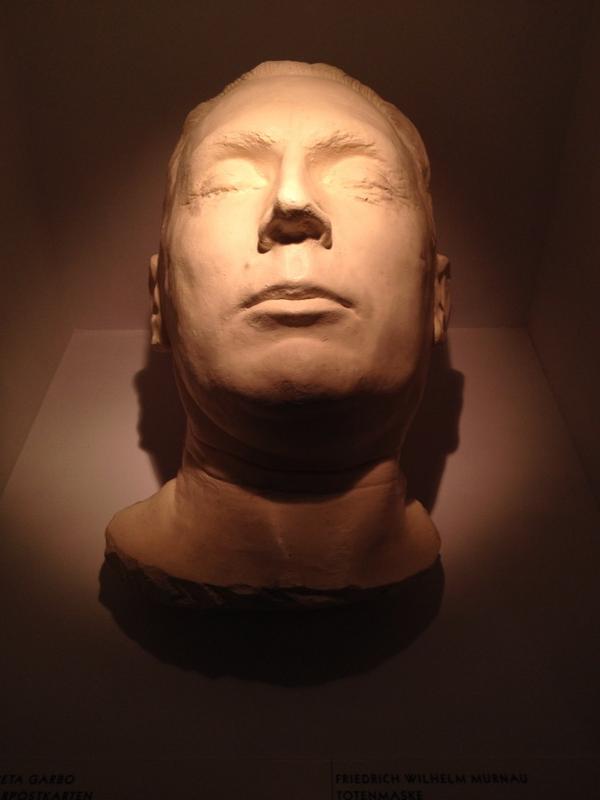
FW Murnau death mask
Murnau died on March 11, 1931, after suffering a head injury in an auto accident near Santa Barbara, California. Only 11 people were in attendance at his funeral, including Emil Jannings, Greta Garbo, and Fritz Lang, who delivered the eulogy. Garbo, in fact, had his death mask made and kept it on her desk for many years.
Of the 21 films Murnau directed, eight of them are known to be lost. But of his remaining films, Nosferatu has survived to influence generations of filmmakers as one of the greatest horror films ever made. And for that, we are fortunate.