

Director: Andrew Leman
Stars: Matt Foyer, John Bolen, Ralph Lucas
Snack Report: Pirate Booty (white cheddar faux popcorn)
After two consecutive nights of horror films full of gore and sex (I really didn’t plan it that way, honestly), I thought it might be nice (and less stressful) to do something completely different tonight.
With just three nights left in the 31 Fright Nights Challenge, I realized I hadn’t yet screened any films based on the works of HP Lovecraft.
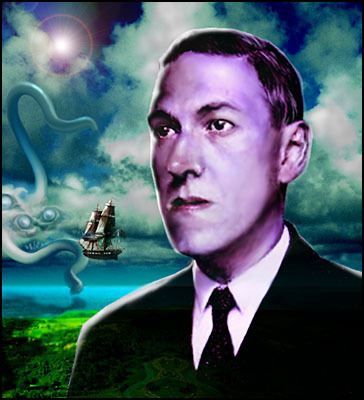
If you’re not familiar with Howard Phillips (HP) Lovecraft, he was an early 20th century horror/fantasy/sci-fi author, the godfather of what is referred to as “cosmic horror” fiction – stories in which the human perception of existence is just a weak construct protecting us from the reality of a universe so alien and abstract that we could not experience it and remain sane. Lovecraft’s nihilistic tales hold out no hope for the human race against malevolent alien/pre-human forces seeking to destroy us.
In a way, I suppose it doesn’t sound very appealing, but I would argue that it does make for good horror fiction.
Perhaps that’s why Lovecraft didn’t enjoy much commercial success during his lifetime (or maybe he was just really bad at marketing). He died penniless in 1937 at the relatively young age of 46.
In the afterlife, however, he has achieved an astonishing popularity. His hometown of Providence, Rhode Island, does a terrific business in Lovecraft tourism, and his name is plastered on everything from literary prizes to beer cans to regions of Pluto. Lovecraft has in death achieved a degree of critical (and pop culture) success beyond anything he ever imagined. In fact, he’s now considered one of the most influential horror writers of the 20th century.
In any case, I’m a great fan of Lovecraft’s work, and I considered Re-Animator (1985) and In the Mouth of Madness (1995) for tonight’s film. Instead I chose The Call of Cthulhu because I have a particular love of silent film, and because you’re less likely to have heard of it, I wanted to share it with you.
What makes The Call of Cthulhu so unique? For one thing, it runs only 47 minutes. And as I mentioned, it’s a black-and-white silent film.
(One thing about silent films – you can’t just “half-watch” it. You have to pay attention. This film jumps from story to story, from location to location so quickly, you can’t get up for a snack or to let the dog out without missing something.)
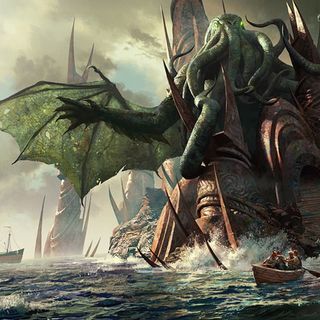
The Call of Cthulhu is perhaps the most faithful film adaptation of any of Lovecraft’s tales, based on his short story by the same name. It is, in fact, the only one of his stories that the giant squid-headed monster – indeed, Lovecraft’s most popular and enduring character – appears in, though it’s probably his best-known work. Many of Lovecraft’s other stories would be easier to adapt to the screen (and many have been, with bigger budgets, and less successfully), but the dedicated folks at the HP Lovecraft Historical Society went for it and nailed it.
Clearly a labor of love, The Call of Cthulhu is shot in the style of the silents of the 1920s, as if the story were filmed at the time when the short story was published. It almost looks like a movie that could have been made during Lovecraft’s lifetime.
*****
The narrator, (Matt Foyer), described in the credits only as “The Man,” is dying, and he’s appealing to his psychiatrist for help – he wants him to destroy all his papers.
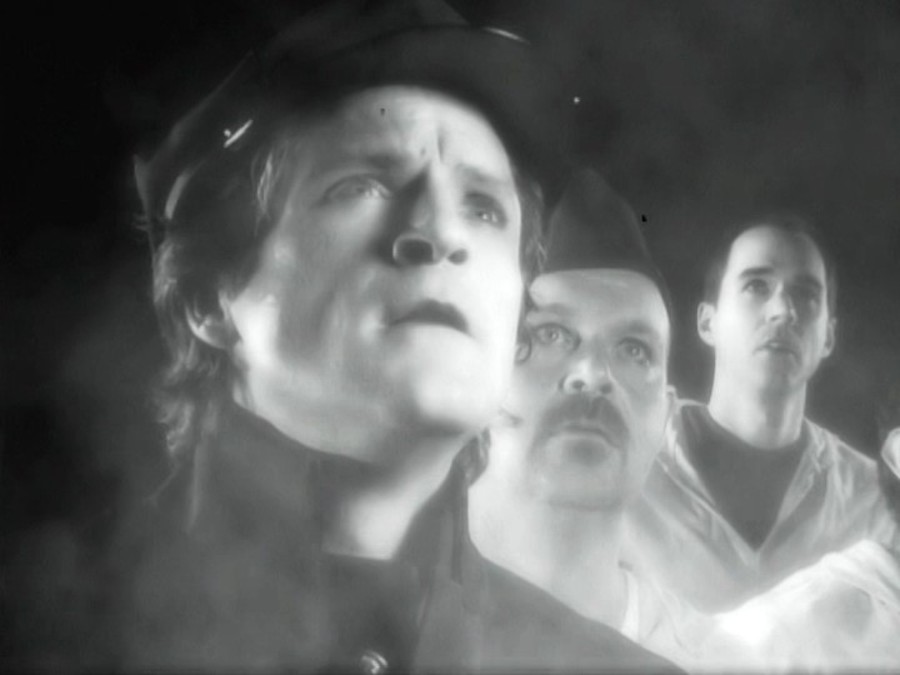
In a story within a story, he tells his own tale as well as the recorded experiences of three other men:
- A young artist who went mad dreaming of Cthulhu and the dread underwater city of R’lyeh.
- Inspector Legrasse, who investigated the cult’s activities near New Orleans and witnessed the cult’s ceremonies.
- The sailor, Johansen, who went to the island of R’lyeh and saw the Eldritch Abomination of Cthulhu for himself.
Each story takes place in a different time period; the first in the 1920s, then in flashbacks to 1908 and then to the 1870s.
The narrator reveals that he was caught up in the mystery when his elderly great-uncle, a college professor, passed away and left him all his papers and records of his life’s work. He discovers that his great-uncle was tortured by a lifelong obsession with a strange and terrifying cult of an ancient god, lurking beneath the sea for eons, who will awaken “when the stars are right” and rise to exterminate the human race.
His curiosity piqued, he himself begins to investigate further the study that his great-uncle began. Which as you probably guessed, was a mistake. The deeper he gets into the cult, the further his sanity erodes, and it takes its toll on his body and mind.
At last, with his own death imminent, he tells the story and passes on the documents to his psychiatrist, begging him to destroy them. But of course, he doesn’t. Like any other mortal, he cannot help but be drawn in by the call of Cthulhu, and the cycle begins again.
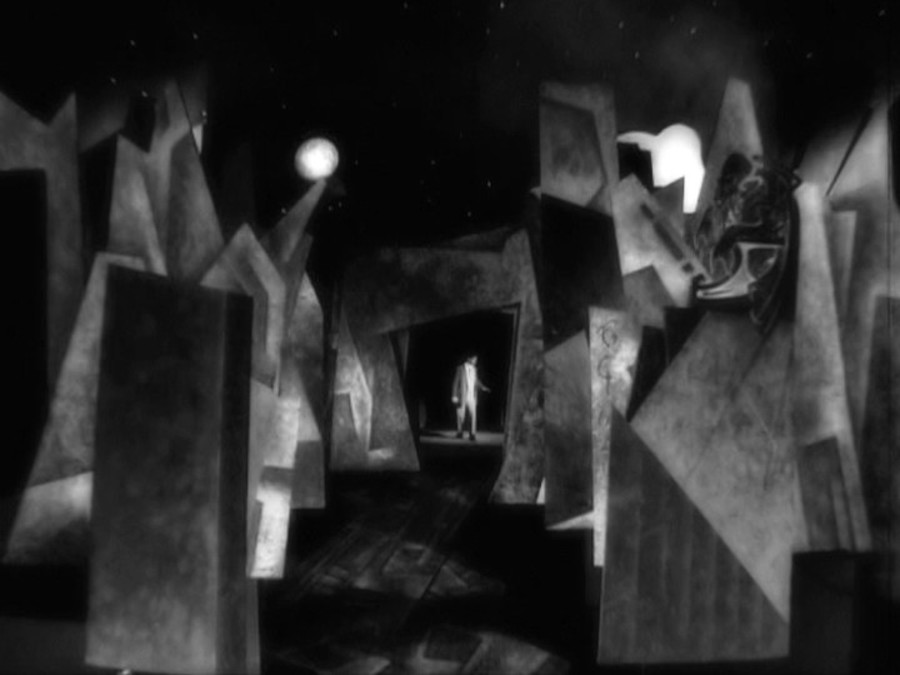
 The best sequence is the story of the sailors, who know something’s not right as they disembark at R’lyeh (where Cthulhu lives). Animating Cthulhu would have been a daunting task in the early days of filmmaking. They didn’t have CGI, but they did have stop-motion animation in the style of Ray Harryhausen and Willis O’Brien. Sometimes I think I’d rather watch that than the ultra-real uncanny valley stuff we have today. The animation may be rather primitive, but it’s genuinely scary when Cthulhu climbs out of his crypt and looms over the terrified sailors.
The set designers even created the skewed geometry of the island as per Lovecraft’s description, no doubt inspired by The Cabinet of Dr. Caligari (1920) (Fright Night #20), Metropolis (1927), and other German Expressionist films.
As I mentioned earlier, The Call of Cthulhu exists thanks to the HP Lovecraft Historical Society, a group of fanatical Lovecraft enthusiasts who conceived, wrote, and produced it. I can’t think of anyone better to bring Lovecraft’s best known story to the big screen for the first time.
*****
Here’s a little movie/Lovecraft trivia…
- Stephen King cites Lovecraft as a huge influence, calling him “…the twentieth century’s greatest practitioner of the classic horror tale.”
- Filmed in “Mythoscope,” a combination of vintage and modern film techniques to create the look and feel of a silent film.
- IMDB estimates that the entire budget for this film was about $50,000.