
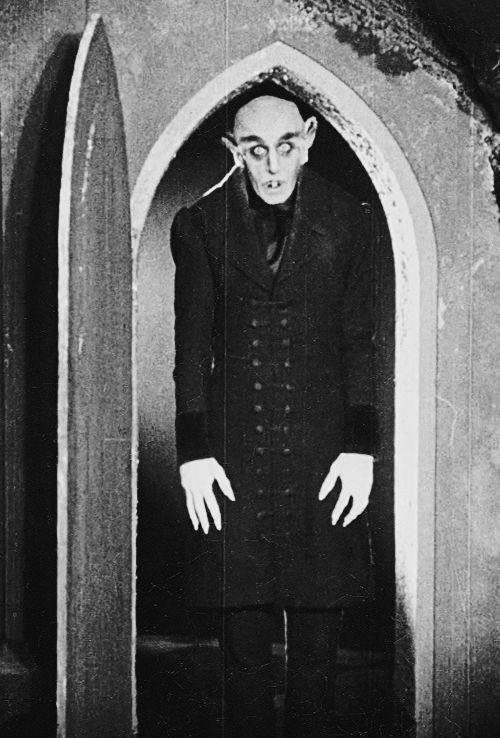
Director: FW Murnau
Stars: Max Schreck, Gustav von Wangenheim
Snack Report: Chocolate chip cookies
Viewing Companions: Zelda, Mr. Falbeaux
I’m a huge fan of the horror classics, so it was only fitting that I kick off the first Fright Night with the film that started the whole vampire movie tradition – FW Murnau’s Nosferatu: A Symphony of Horror (1922).
Nosferatu was initially released in Germany in 1922 but didn’t make it to the US until 1929 due in part to legal troubles. The filmmakers assumed that changing a few details like the characters’ names and location would be enough to escape copyright laws. They were wrong – Bram Stoker’s widow sued, and all known copies of the film were ordered destroyed. Luckily for us, at least one survived.
Co-producer/set designer and lifelong occult aficionado Albin Grau is responsible for much of the look and feel of the film, but it’s Max Schreck as the mysterious title character who really makes Nosferatu unforgettable. Count Orlok isn’t your classic vampire archetype. He’s a creeping, feral predator, more at home with rats than bats, and his appearance is hideous and unsettling. He couldn’t be more different from the suave, seductive aristocrats we associate with the Count in later portrayals by Bela Lugosi and Christopher Lee.
Though it can be tempting today to think less of Nosferatu for its primitive effects, the truth is that it’s suspenseful, poetic, hypnotic… a work of art. And even though I’ve seen it many times, I still get serious chills when Count Orlok rises up from his coffin and when he’s stalking Mrs. Hutter.
Nosferatu was once described by legendary director Werner Herzog as the greatest vampire film ever made. In fact, he loved it so much he made a movie about the making of the movie – Shadow of the Vampire (2000) – where lead actor Max Schreck was a real vampire (also worth checking out!).
Your mileage may vary, but for my money, Nosferatu is definitely worth revisiting every now and again. I think it holds up pretty well for a nearly 100-year-old film.